Reaching the Climax at Camp Miasma
Written by Carson Jane Robles
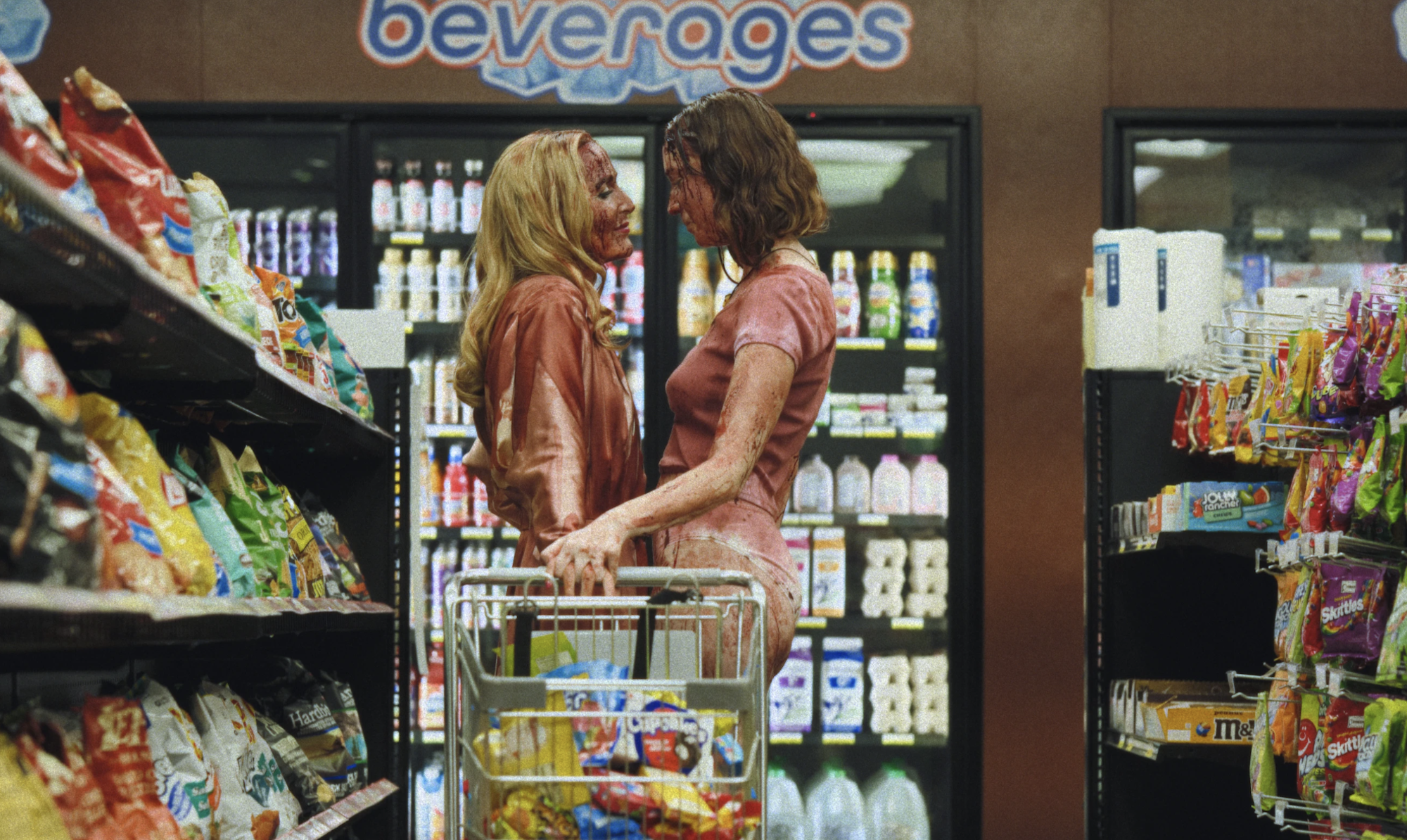
Outside the Syndicated Bar Theater and Kitchen, I light a capri and pull Eve’s Hollywood out of my bag. My eyes skim letters without reading them. A knot tightens around my intestines as a half-stranger climbs out of their Subaru and approaches my periphery.
“Hey, I’m so sorry, traffic was crazy,” says my new curly-haired romance, three minutes from being ten minutes late.
“It’s okay!” I smell pine and amber in their hair as we embrace, and I have already forgiven them. “Smoke?”
They finish off my cigarette and lead me inside.
We are on our third date in the second row of the first movie we will ever watch together: Jane Schoenbrun’s Teenage Sex and Death at Camp Miasma. We have made it just in time for the last trailer, an action movie with a loud, bad score and Glenn Powell, probably. I try to start some meandering conversation, but the lights dim. We turn to face the music.
Teenage Sex and Death at Camp Miasma is a film about orgasm. This is not something I knew when pitching it as a date movie. Fortunately, Schoenbrun is generous enough at least to bury the lede with thirty minutes of campy-slasher-horror-comedy foreplay.
In these thirty minutes, I nurse a tequila soda (paid for by my date, thank God) as my hand rests on my lap, garish with anticipation and solitude.
It is just as I feel the brush of fingernails tiptoe across my forearm that Schoenbrun demands our attention: Hannah Einbinder and Gillian Anderson are having sex onscreen.
Here is a little bit about the film I am almost paying attention to:
Kris (Hannah Einbinder) is a wunderkind filmmaker tasked with reviving the eponymous horror series Camp Miasma. Billy Presley (Gillian Anderson) is the enigmatic star of the original Camp Miasma film who has since absconded from the limelight to a secret cabin in the woods. As my date and I have been silently wilting towards each other, Kris and Billy have been dancing the same tango. After a half hour of maneuvering around one another, the two have finally found each other in bed.
Where the rest of the film has been indulgent, campy, and absurd, Kris and Billy’s sex is fatally human. Hands move to awkward places and pleasure slips from their grasp. Eventually, Billy admits that sex has been nearly impossible for her since she was assaulted during the filming of the original Camp Miasma. Kris, on the other hand, confesses that she cannot orgasm unless indulging in a violent fantasy where she is slaughtered as a horror victim.
“Where the rest of the film has been indulgent, campy, and absurd, Kris and Billy’s sex is fatally human. Hands move to awkward places and pleasure slips from their grasp.”
Their sex ends in serene resignation with orgasm drifting out of reach.
The hand to my left retracts and grabs for its gin and tonic. I pull my hand away too. The air is thick with sudden sincerity.
The knot in my stomach reappears. I am thinking too hard about sex for a third date. I project myself onto the women of the film, remembering that I have a relationship to my body, to sex. What a nightmare.
It takes an hour of Schoenbrun’s fatalistic humor and indulgent gore for me to realize that the hand to my left has reappeared near my lap. Within that hour, we have become familiar with the monster of Schoenbrun’s slasher.“ Little Death,” embodied with deadpan angst by Jack Haven, is a prototypical horror villain. He/she is a complicated figure, inspired shamelessly by the androgynous antagonist of Sleepaway Camp; like Angela of that series, Little Death’s motives for violence stem from his/her incompatibility with the gender binary.
Little Death is also the key to unlocking orgasm. Billy explains that the only way she was able to rediscover her sex was by indulging in the fantasy of Little Death killing her. Billy encourages Kris to explore this fantasy.
So there I am, seated in the Syndicated Bar Theater, white-knuckling a gin and tonic with my right hand and the elbow of a partial stranger with my left. We’ve finally found each other as the film crescendoes in front of us. Kris has been running from Little Death for ten minutes, and has found herself back in bed with Billy once more, this time with new indulgence.
Per Billy’s guidance, Kris has let herself become the final girl.
With a sweeping, symbolic gesture, Little Death penetrates Kris with the spear. At once, the film and Kris reach climax.
In this absurd, orgasmic peak, the knot stuck in my stomach tumbles out through my tear ducts. I am crying. I release my clenched fists and peel my head off the shoulder next to me to wipe my eyes. As I move, I notice that the half-stranger to my left has turned away, quietly wiping similar tears. Behind me, a mustachioed man in Carhartt and his skinny, tattooed girlfriend treat their own wet eyes. And to my right, a lone woman with dyed-red baby bangs lets tears roll down her face without apology.
Here we are, a theatre of snooty intellectuals and half-drunk sentimentalists, united by some soggy-faced, snot-nosed ailment.
I think of Aristotle.
Specifically, I think of Aristotle’s Poetics and his invention of“ catharsis”:
Tragedy, then, is an imitation of an action that is serious, complete, and of a certain magnitude; in language embellished with each kind of artistic ornament, the several kinds being found in separate parts of the play; in the form of action, not of narrative; through pity and fear effecting the proper purgation [κάθαρσις, or catharsis] of these emotions.
S.H. Butcher translates κάθαρσις (catharsis) as purgation: an expulsion of the“ pity and fear” intrinsic to tragic poetry.
“The Syndicated Bar Theater has fallen victim to catharsis. We are letting the pity and fear spill out the corners of our eyes. Schoenbrun has wielded Aristotelian structure as a weapon with which to purge our horror.”
Poetics is a definition essay—defining Epic poetry against Tragic, Comedy against Dithyrambic, and Tragedy against Comedy. Catharsis, as Aristotle uses it, defines only tragedy. Elizabeth Belfiore explains in Pleasure, Tragedy and Aristotelian Psychology that“ Aristotle says nothing at all about the tragic catharsis in the Poetics except to state that tragedy accomplishes it” (349). And in fact, the only context that he gives to catharsis is the“ pity and fear” which it expunges.
Aristotle, the pragmatist that he was, developed a straightforward roadmap by which writers could guarantee emotional response. All that you need is to invoke pity and fear, and then, by expunging them, you create catharsis. Of course, Aristotle also provides a clear directive by which to achieve this pity and fear:“ for pity is aroused by unmerited misfortune, fear by the misfortune of a man like ourselves” (XIII).
We must feel that our protagonist is undeserving of their misfortune, and we must feel that our protagonist is“ a man like ourselves.”
My tear-stained hand wanders back to its old resting spot as onscreen flowers bloom, the sun rises, winter turns to spring. I melt into the shoulder to my left with a hapless optimism for the possibility of intimacy, of romance.
“I melt into the shoulder to my left with a hapless optimism for the possibility of intimacy, of romance.”
Little Death’s name is a reference to the French phrase, le petit mort, which refers to the catatonic, death-like state following orgasm. The last quarter of my cinematic experience resides in this death-like state, as I wonder, why has Schoenbrun done this to us?
Catharsis is a political act, and one that Schoenbrun has avoided in the past for the most part. Her prior two films, We’re All Going to the World’s Fair and I Saw the TV Glow both end with abrupt question marks. I recall sitting in the theater for ten minutes after I Saw the TV Glow as pity and fear reverberated through my nervous system. It took a cigarette and a hefty dose of Cowboy Junkies to purge those horrors from my body.
Here, Schoenbrun has done the work for us. That taut feeling of anxiety—towards sex, violence, bodies—has been replaced with romance.
In Schoenbrun’s slasher film, Little Death and orgasm are monstrous. In Teenage Sex and Death at Camp Miasma, orgasm itself is violent, penetrative, and rife with pain. It is also essential. Pleasure is neither optional nor avoidable in Schoenbrun’s thesis of sex.
“In Teenage Sex and Death at Camp Miasma, orgasm itself is violent, penetrative, and rife with pain. It is also essential. Pleasure is neither optional nor avoidable in Schoenbrun’s thesis of sex.”
And so, it takes a mountain of discomfort, a steep hike through self-reflection, and a reckless embrace of fantasy. But, on the other side of all this pity and fear is the guarantee of some climactic catharsis.
A third date still feels early to be thinking so much about sex. But, as this curly-haired sentimentalist drives me back to Bed-Stuy, I allow myself to indulge. I curl their fingers around mine and relinquish my body to the reverie of romance.