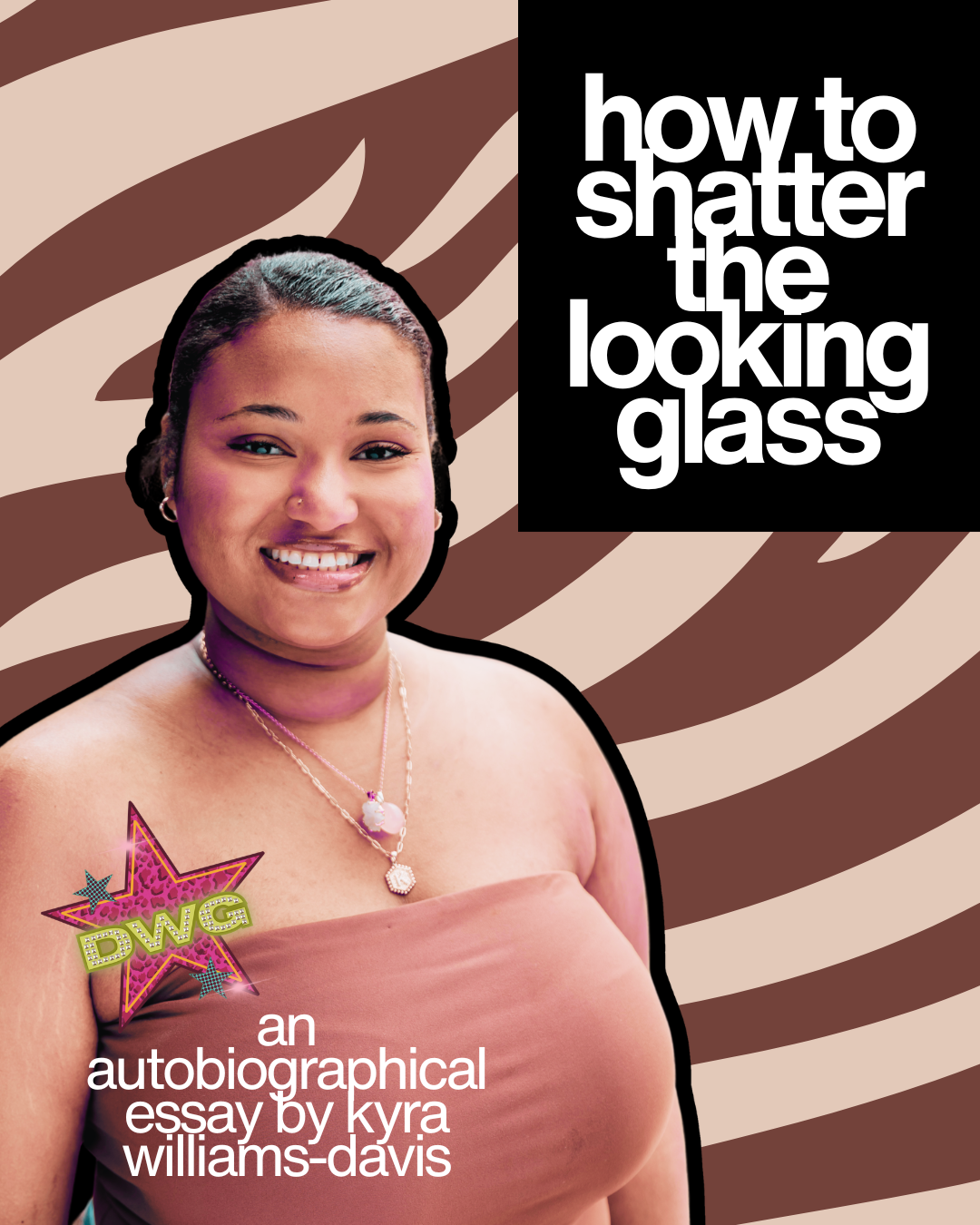
How to Shatter the Looking Glass: An Autobiographical Essay
Written by Kyra Williams-Davis
The summer before I started college, I knew exactly who the hell I was and who I wanted to be. I knew I had a 3.9 cumulative GPA. I knew I’d gotten accepted to every school I applied to (minus Harvard, but that’s a conversation for C. Wright Mills and the theory of the Power Elite). I knew I was someone that my family and friends were proud of and looked up to; I was proud of myself too. I was someone who had immense talent and was destined to share it with the world. I was competent; I was smart; I was respectable; I was brilliant. I was nurturing, confident, and I didn’t care what anyone thought of me. And I had the nerve to be all this and a Black girl at the same time. My sister and my dad were the only ones in my family to attend college, prior to my acceptance. My sister and I were born with every odd stacked against us, being natives of an underprivileged city, living in an underserved area, and being students at schools that the state didn’t think twice about. On top of that, we were born with an identity that gave society an idea of who and what we’d become before we even got a chance to prove them wrong. Luckily, my parents knew better. They knew that their child would not simply be what the rich white folks in the Detroit suburbs thought of me: an uneducated criminal bound to be pregnant and on drugs by the age of sixteen. Through their discipline and guidance, I knew I’d go to college and prove those rich, white assholes wrong.
The very action, let alone the thought, of gaining knowledge beyond what has been prescribed to you your whole life is transformative. It makes you human. This is the entire reason I knew I wanted to pursue higher education. According to the rest of the world, I was something other than human, or at least I was not of the same kind of humanity as them. I didn’t deserve to have the same human experiences as white people, nor did I deserve to expand my understanding of the world, expand the passions that fill my soul and embark down the journey of higher education. I didn’t deserve it, in their eyes, because I was meant to be what they wanted me to be, not who I knew I was.
The Looking Glass Self is a term coined by sociologist Charles H. Cooley. The theory states that we perceive ourselves based on how we believe others perceive us. I am who I think you think I am (try saying that five times fast). Growing up, I didn’t need to be told I was kind, funny, smart, or anything of the like. I knew it myself because of my grades, my friendships, the way others belly-laughed at my jokes, and the way I made my parents proud. I believed people perceived me as a competent, young Black woman who could be anything she wanted. Therefore, that is who I was, and that is the person I projected when I moved through the world. I saw myself as someone worthy of being in this space and absorbing all the knowledge that Bowling Green State University, this mid-size predominantly white institution with ugly school colors, had to offer. Being only one of ten Black girls out of hundreds in my residence hall, one of two Black girls in my biology class, and one of five in my psychology class didn't faze me. I was smart; I was ambitious; I was sure of my power and my impact on the world. However, as I was gaining this new breath of mind and soul, I also started seeing myself the way these white folks had actually viewed me the entire time.
“Growing up, I didn’t need to be told I was kind, funny, smart, or anything of the like. I knew it myself because of my grades, my friendships, the way others belly-laughed at my jokes, and the way I made my parents proud. I believed people perceived me as a competent, young Black woman who could be anything she wanted. Therefore, that is who I was, and that is the person I projected when I moved through the world.”
It was like being hit by a brick wall that appeared before I even finished blinking. I didn’t expect it. I didn’t know how to deal with it, and I knew it made me mad. All of a sudden, the person I knew I was had been roped up in an ongoing war with someone that all these people at my PWI thought I was. I flushed red when I heard the giggles of white girls in my group, all of them amused that I didn’t know how to measure dissolved oxygen. I was getting extra help from my professors, completely unprompted. I was told left and right how amazing I probably was in bed and that my body was just so hot (I was a virgin). I was also complimented on being“ fierce” or“ sassy” whenever I stood up for myself. I started to water myself down to fit in with the image everyone else saw. Everything that I knew I was—nurturing, intellectual, confident—was irrevocably tainted by a version of me that I had no part in creating.
“I started to water myself down to fit in with the image everyone else saw. Everything that I knew I was—nurturing, intellectual, confident—was irrevocably tainted by a version of me that I had no part in creating.”
One day I was living as this girl that I had known and come to love for eighteen years, and the next, I was someone that my peers determined fit me more appropriately, someone that I did not recognize. What hurt the most was that no one ever said to my face that I was a dumb, loud, aggressive, ghetto, and sex-crazed Black girl. They didn’t have to. They did it in secret, in their minds, subconsciously. They had taken from me the power of self-image. I knew this was happening, and yet I could not do anything about it. I couldn’t be the person I knew I was, and I couldn’t live the life I imagined for my college self, out of fear of proving them right. It was an impossible paradox to live in, yet for a time, I believed them.
As a woman with my identity in question, this period was internally tumultuous. But as a Black woman, I was reminded of the writings of Helene Cixous, specifically her 1975 work,“ The Laugh of the Medusa.” Was I a monster? Should I shut my mouth, swallow the fear, the shame, the horrificness of my own monstrosity so as to not speak in vain? Was I a fool guided by my own audacity to believe that I was not who I always thought I was?“ Who surprised and horrified by…her drives…hasn’t accused herself of being a monster?” (Helene Cixous,“ The Laugh of the Medusa”). This version of myself that I had come to know, to love, to believe in to the highest degree was all of sudden“ revealed” to be this imaginary, ugly thing that had no basis, no factual standing in the supposed reality of who I actually was according to my white peers. She was fake. She was an illusion. She was, simply put, not the“ real” me.
Looking back on this moment, I can say that this was my worst fear come true. Society had taken my identity from me, and I let it hold her hostage. I couldn’t speak out against it, as Cixous points out, because I was made to feel ashamed of that self-advocacy, of that competency, of the joy I found in being my true self, and of the person my parents had so desperately hoped to eke out of me. I laugh at it now, because where is the logic in fitting in with an image projected onto you by people who have no idea what it’s like to be you?
I had spent so long attempting to be both this image of the stereotypical Black girl and disprove said image. I wanted to find my place and where I fit in amongst the crowd, and also try not to lose the person I knew I was truly at my core. Near the end of my third year in college, it was like the brick wall I was so desperately trying to get past was finally, slowly, coming down. I was beginning to see past the façade and into the horizon of truth. I was at this PWI as a Black girl and I was infringing on this place meant for white people to succeed in their mediocrity. I was someone who, with every odd stacked against her, was not supposed to be here. Nevertheless I was, and I was giving these white folks hell and a run for their money, as they could no longer hide behind their mediocrity when I entered the room. My peers and professors had this delusion about me that was none of my business. It had everything to do with their intimidation of me and others like me. They could not grasp that I actively challenged their tired archetype of a Black American. They had to disperse those feelings that bubbled up within them, those feelings of incompetency and uncertainty, and project them back onto me, trying to force me to become someone they and I both damn well knew I was not.
“They had to disperse those feelings that bubbled up within them, those feelings of incompetency and uncertainty, and project them back onto me, trying to force me to become someone they and I both damn well knew I was not.”
Since the onset of the institution of slavery, Black Americans have been made to feel and be objectified—their“ property” status made it easier to rationalize their“ inferiority” when compared to the masters. Black women were a whole other beast, made to be not only inferior, but the ultimate source of the exotic and erotic. Even still, we had no place being equal to any white person, especially in an academic setting. The historical implications of the treatment of Black women altered the ways in which I experienced the world. The life that was only mine and no one else’s to tamper with was being ripped apart due to a history that I just so happened to be a part of. It was being ripped apart because my white peers had to justify their own mental struggle with how my presence made them feel. Something that’s important to realize, and something I had to realize, was that even though my white peers made me have this“ battle of the looking glass selves” in the first place, they also had their own identities and personal lives wrapped up in the historical context of this country. We were both, in a way, experiencing some form of temporal harm: they experienced it by ways of being told they were the greatest people to ever live, that they did not have to put real work into developing who they were and how they live their lives.
What helped me most in my fight were the friendships I made with other Black women. We were all in the same place in life, all struggling with our own identities and having to grapple with saving them from the confines of our peers’ own identity crises. In this, I realized we were all uniquely and beautifully different.“ …there is, at this time, no general woman, no one typical woman…what strikes me is the infinite richness of their individual constitutions…Women’s imaginary is inexhaustible, like music, painting, writing: their stream of phantasms is incredible” (Helene Cixous). With this friend group, I was seeing firsthand the power Black women had in being their unapologetic selves, the self that was not imposed upon them by others. There was power in our laughter, in our hobbies, in our passions, in what made us cry, in what made us mad, in who we are . If I could see the proof right in front of me, that the group I belonged to was not a monolith, who were my peers to tell me otherwise? Sure, some of us were loud, some of us were sassy, and fierce, and some of us really did know what to do in the bedroom, but it was refreshing and eye-opening to see that we could be those things and at the same time, not be reduced to a singular story that dictated our experiences as scholars.
This experience made me realize my true power and helped me develop my sense of self. I lived my life no longer with the goal of fulfilling the identity placed upon me or with the goal of disproving the identity placed upon me.“ The aim of each thing which we do is to make our lives and the lives of our children richer and more possible. Within the celebration of the erotic in all our endeavors, my work becomes a conscious decision- a longed-for bed which I enter gratefully and from which I rise up empowered.” (Audre Lorde,“ Uses of the Erotic”). Just as Lorde speaks about the erotic—not in the sense of the site of oppression with which it has predominantly been used, but as assertion of lifeforce—the reclaiming of language and history and our love, our work, and our lives, that is how it felt to reclaim the person I always was and untangle her free from the person my peers had so desperately tried to turn her into. Perhaps that is why my peers and professors fought so hard to do what they did. Maybe they didn’t want me to look at myself and my true power, the power of my own source of the erotic, in this way. Because the sooner I realized this power, the sooner they had to finally admit defeat and recognize that who they attempted to define me as and the harm they aimed to do would no longer be viable.
“Maybe they didn’t want me to look at myself and my true power, the power of my own source of the erotic, in this way. Because the sooner I realized this power, the sooner they had to finally admit defeat and recognize that who they attempted to define me as and the harm they aimed to do would no longer be viable.”
And, even now in my work, even with all the experiences and knowledge and expertise I have, even with two degrees under my belt, I still struggle with this internal battle of selves from time to time. The fear that one day, the thoughts of my white peers all those years ago will manifest and come back and I will suddenly be found out for the fraud I am. Everyone will realize I have no place within this institution other than being a site of comparison for which my white colleagues and the white students around me can use to make themselves feel better about their own shortcomings. Well, at least I’ll never be as bad as the Black girl, I can imagine them saying with an unearned tone of victory and arrogance and self-satisfaction in their voice. But then I remember that eighteen year-old girl who was so sure of herself. I remember the beauty of her friendships and her relationships, I remember her experiences, and I remember that I am her. I remember who the hell I am. And I remember that no matter how much one person or group of people try, they can never take my true self away. They can never steal my essence in the hopes of using it to revitalize their own. They’ll have to find their own brilliance elsewhere, within the deep recesses of their own mediocrity.