Dance, Damnit!: On Queer Joy, the Dance Floor, and Giving a Fuck as a Radical Act
Written by JJ Baysinger
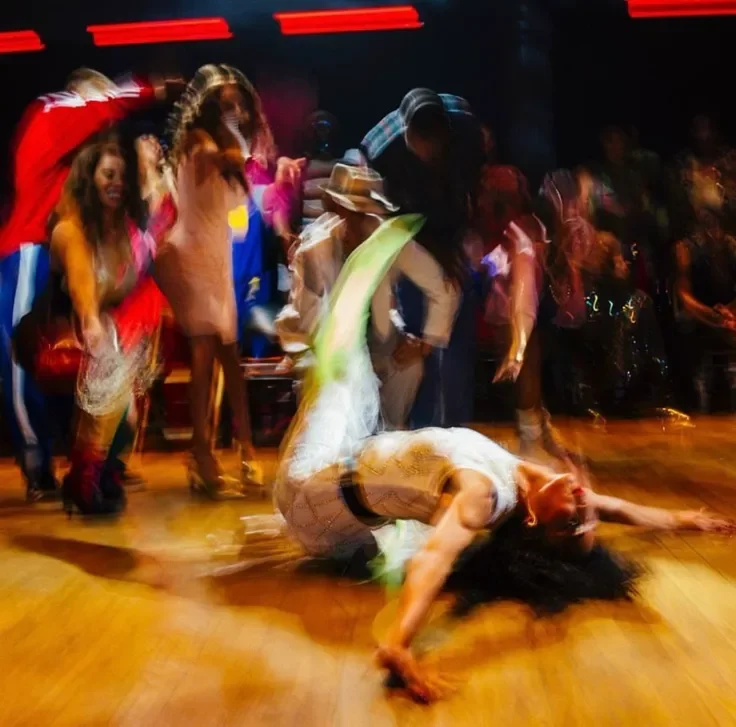
On Day 0 of Coachella, I watched Disco Lines play to a wall of cellphones. Not a metaphor, by the way. There was quite literally a forest of phones surrounding the booth, raised high like tall trees, recording everything.
The floor was full and nobody was moving. Even the“ booth baddies” were barely swaying. Instead, they stood perfectly posed, arms raised, screens lit, ready to capture the moment they refused to actually participate in. Not because the music was bad, obviously, but because visible enthusiasm, in 2026, is a liability. Everybody is afraid of being clipped or mocked or ratioed, and therefore, the people are recording instead of reacting.
I can’t help but think of the people who stole the dance floor, left the politics behind and helped foster this sort of indifference towards physical liberation.
Here is some history you might not know:
In 1977, a Black gay DJ named Larry Levan opened a club in a parking garage in Manhattan. Paradise Garage, the club, became one of the most radical rooms in American history, and it was a sanctuary for its predominantly Black and Latino queer clientele.
The wooden dance floor was built on top of sand and springs so people could dance until noon.
There was no alcohol. No food. Just music, and the practice of existing in public without apology.
Levan’s sets were called “Saturday Mass” by the regulars. People wept on that floor. They buried friends and came back the next weekend, as joy, for them, was medicine.
ACT UP, the AIDS Coalition to Unleash Power, focused on joy explicitly.
They made dance parties a formal component of their organizing strategy, described by one coalition member as “the combination of serious politics and joyful living” (Powell, 2022).
To move your body in public, as a queer person in America, is and was always a political act. The dance floor was where we rehearsed it.
Mainstream culture strip-mined the aesthetics of that floor and discarded everything else. The music traveled but the philosophy didn’t make the trip.
“The music traveled but the philosophy didn’t make the trip.”
Meanwhile, the physical spaces themselves disappeared. According to sociologist Greggor Mattson’s landmark study published in Socius, between 2007 and 2019, gay bar listings in the United States declined by 36.6 percent, and the losses were not evenly distributed; lesbian bar listings fell by 51.6 percent, while bars distinctly serving people of color declined by 59.3 percent. The spaces that most prominently embodied radical presence closed at the highest rates. Essentially, the masses inherited the playlist while the community lost the rooms.
Dance halls,sweaty spaces and clubland were built specifically because they were among the only places queer people could exist without being surveilled and punished for it. A phone on the dance floor is not simply a“ vibe killer,” it’s also disrespectful. It is a reversal of the entire premise. Documentation was, for ages, the very weapon used against queer communities. Now, at a festival playing music born directly from their parties, we are doing it to ourselves and calling it content.
Yikes!
As adrienne maree brown argues in Pleasure Activism:“ There is no way to repress pleasure and expect liberation, satisfaction, or joy.” The people who built the dance floor understood this very fact not as a lifestyle choice but as a thesis. They did not build the floor so you could document it. They built it at great cost, with great love, so that joy could not be surveilled, commodified, or made ironic. That inheritance belongs to all of us now, which means we have some obligations.
“[the people who built the dance floor] did not build the floor so you could document it. They built it at great cost, with great love, so that joy could not be surveilled, commodified, or made ironic.”
So: know where the floor came from. Put your phone down for at least one song, and be embarrassingly, visibly, audibly, physically invested in something. We owe it to those who came before us to actually dance.