Buttons, Bratz, and the Death of Beige: Inside the Beautifully Chaotic World of Kaliyah Killens and I.CONIC
Written by Aaliyah Smith
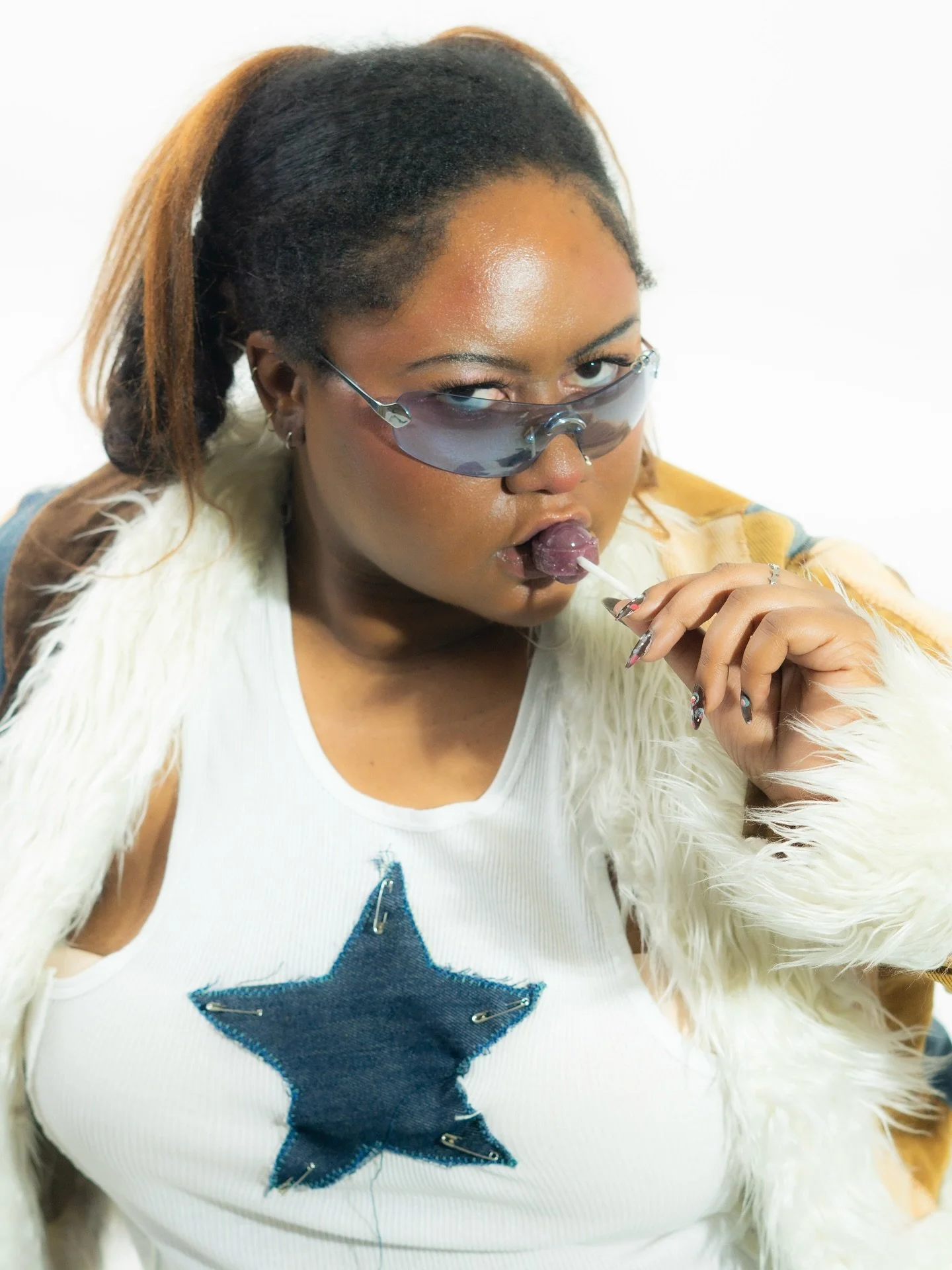
Image courtesy of @erithevisionary
Kaliyah Killens started talking about buttons about twenty minutes into our conversation.
Not necessarily in terms of fashion. To her, buttons seemed more like something rescued from the back of a drawer, something that used to belong to someone she loved. Little objects with memory inside of them.“ My mentor told me,‘ Make stuff from buttons. They’re everywhere,’” says Killens.“ Most people don’t think about buttons, but they’re such an everyday object [that] you can turn into wearable art.”
That's when I understood what I.CONIC, Killens’ brand, really stands for.
Ever since she was eight years old, Killens has known she’d move from Oakland to LA and work in fashion. As a child, she prepared with intention by hand-sewing tiny outfits for her Bratz doll collection. She didn’t learn how to do this from a mood board or a trend cycle. She learned it from paying attention to things most people walk past.
That creative impulse never left. Instead, it bossed up into a label.
I.CONIC operates out of LA now, and exists somewhere in the territory between Y2K fashion, sustainability, and a genuine philosophy about what clothing is actually for. The brand incorporates lace and safety pins, softens raw edges with feminine detail, reworks pieces and makes a ton of accessories from buttons (of course). Scrolling through I.CONIC’s Instagram page, something almost immediately feels different, though it takes a second to name that something.
Then it hits you: everybody looks like themselves. The brand only features people whose style is layered with raw authenticity.
The fashion conversation right now is exhausting in a specific way. Every three days something is declared dead. Every week a new aesthetic colonizes the algorithm. Half the internet is dressed in the same four shades of oat milk and graphite.
Killens and I agreed on a name for this“ Colonization of style,” she says, laughing but meaning it.“ Especially for Black, brown, queer folk — we do not be dressed in beige.”
She’s not being provocative for the sake of it, she’s being real. Trend cultures don't just homogenize aesthetics, it specifically flattens the people who were never supposed to be beige in the first place. The ones whose style—layered, loud, sentimental, historically dense—gets extracted, repackaged, then declared over by the same machine that stole it.
“Why dull yourself down just to fit in,” she says, “when you can just be yourself and find people similar to you?”
I.CONIC is a refusal of that machine, not a manifesto. The deeper you get into conversation with Killens, the more you realize style is almost secondary to the feelings and emotions that fuel it.
She told me about a Coach purse she was gifted in elementary school that she still carries because, as she puts it,“ plaid never goes out of style.” She told me about a jacket that belonged to her grandmother, who passed away when Killens was in high school.“ I'll never get rid of it, because every time I see it, I think of her.”
She didn't offer up this information as pure sentiment. It came up because she genuinely thinks this way — clothing pieces should be viewed as archival, as emotional infrastructure, as the physical record of who you were when you wore them.“ People think fashion is frivolous,” she says, “But it’s self-expression just like painting is self-expression. It's all art.”
“clothing pieces should be viewed as archival, as emotional infrastructure, as the physical record of who you were when you wore them.”
Now that's a worldview. A true fashion philosophy.
It makes sense why I.CONIC's community events feel like what they actually are: clothing swaps, markets, spaces where people bring old things and leave with new relationships to them. Killens hosts these events around LA because she loves bringing people together.“ In LA, it can feel harder to make genuine friendships and community,” says Killens. "I want to create that [space] through my brand.”
It’s worth noting that she is doing much of this work on her own.
“At the end of the day, if I’m gonna make it happen, I have to make it happen. A lot of what I’m doing is just me.”
Killens talks about this solo venture without bitterness, acknowledging the gradual negotiation of time that creative survival actually requires, as opposed to the romanticized version people perform online.“ It’s [all about] being patient and flexible and not being so hard on myself, because I’m only one person.”
Killens has been thrifting since middle school, before it became a personality type. Her mom introduced her and her sister to secondhand shopping early. So, when she talks about upcycling now—about taking a pair of pants and turning them into something unrecognizable, then watching a stranger at a market fall in love with it—it doesn’t sound like performed sustainability. It sounds like a continuation of something she's always done.
When I asked about the future, she first reached for a feeling.
“The biggest feeling would be fulfillment. Feeling like all of my hard work and sacrifice didn't go unnoticed.”
Killens also wants a third space — a physical place where she can design, host shoots, and build community in the same room. She named cities she wants I.CONIC to reach: New York, Mexico City, Tokyo. Places, as she put it,“ where fashion lives and breathes.”
When I asked how Killens wanted someone to feel putting on one of her pieces and looking in the mirror, she didn’t hesitate.“ Confident, cunty, like they're that girl, that boy, [that they/them]. [I want them to feel] excited to go out, take pictures, [and] get compliments. Ready to serve.”
Before Zoom finally lost patience with us, I showed her my button-covered headphones.
She loved them immediately, then told me she needed to make more pieces for herself—that she’d originally made the button choker on the site for herself, and then realized she'd given everything away.“ I need pieces too!”
“Shop your own closet,” Killens told me at one point. It sounds like a simple statement, until you realize how countercultural it is — a fashion brand actively asking its customers to want less, buy less, and imagine more.
I’ve thought about our conversation since, because it's the most honest thing anyone building a brand has said to me in a long time. Kaliyah Killens is someone who started noticing things as a kid—buttons, old jackets, Bratz doll proportions, her mother’s eye for a good thrift find—never stopped, and built an entire world from it. Now that’s fashion.