Written by Isabella Grecco
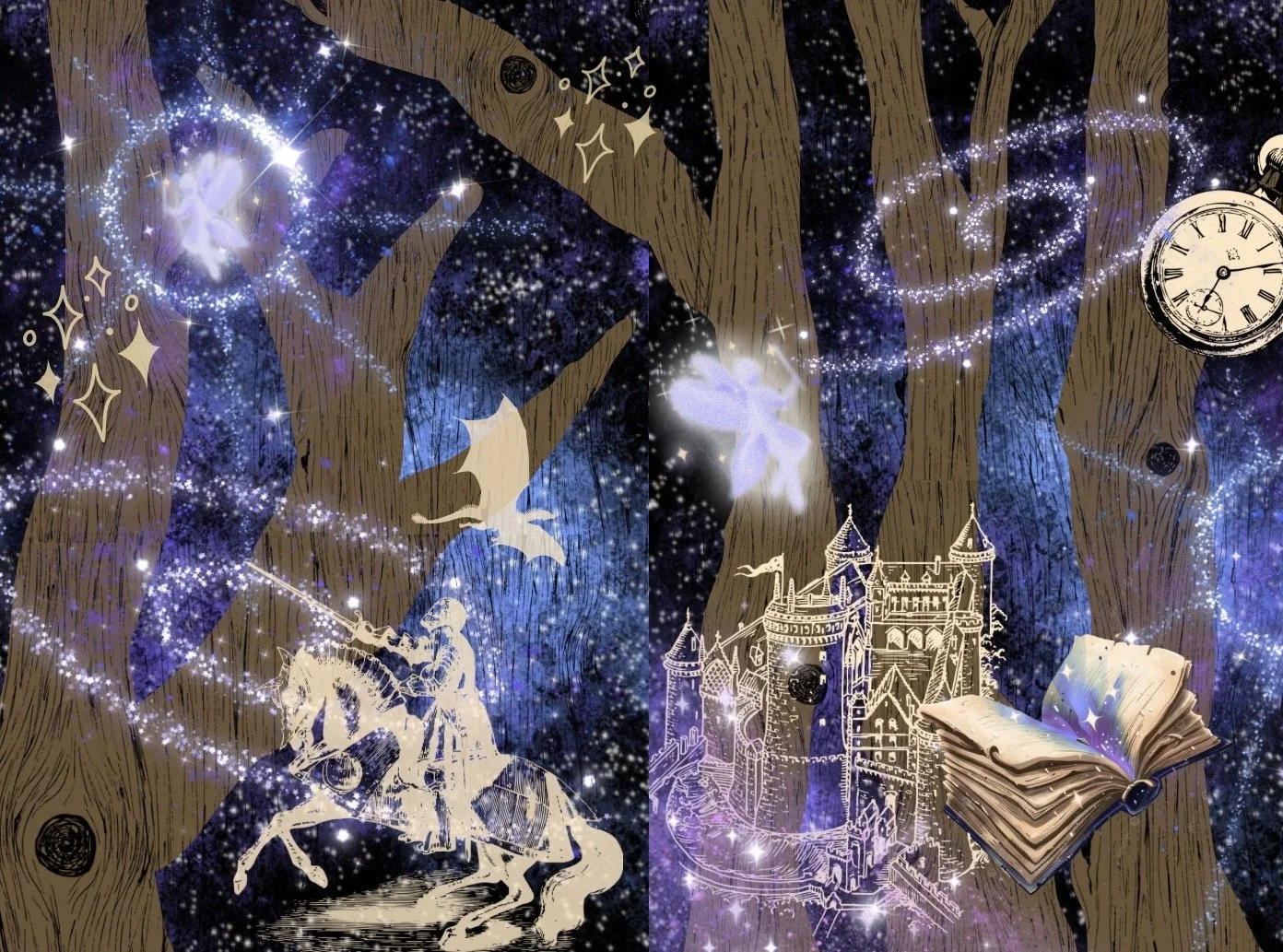
Image courtesy of Isabella Grecco
ABC’s Once Upon a Time (2011–2018) is a fantasy drama series combining classic fairytales with modern-day life. It begins with Emma Swan, a bail bondsperson with a troubled past. After arriving in Storybrooke, Maine, she discovers that the town’s residents are actually fairy tale characters—Jiminy Cricket, Cinderella,and so on—who have been cursed by the Evil Queen to forget their true identities t and live ordinary lives in Storybrooke for the next 28 years. Soon, Emma learns she’s the daughter of Snow White and Prince Charming, and is forced to accept her role as the“ Savior” so that she can break the curse to unlock everyone’s memories and keep them safe. The show explores Emma and her family needing to protect Storybrooke and the Enchanted Forest from dark magic, shifting alliances, and new villains drawn from folklore, mythology, and Disney fairytales. Once Upon A Time also displays examples of multiplicitous self (Anzaldua, 1987) through the character of Regina Mills (Storybrooke identity)/The Evil Queen (Enchanted Forest identity) and travel-hopping (Hayashi; Barad, 2018). Its use of imagination allows for a deeper understanding of self, relationships, time, and reflection in the real world. In doing so, it’s an example of how pop culture can be utilized as a tool to educate about the current structures of 21st century American Society.
The idea of multiplicitous self was first presented by Gloria Anzaldua in her book, Borderlands La Frontera: The New Mestiza, an exploration of identity through her, and many other peoples, experience as a person within the borderlands. People living in-between multiple cultures and identities, such as Chicanas, immigrants, and queer people experience constant negotiation of never fully belonging to one side or the other, but identifying with multiple worlds at once. A multiplicitous self refers to the idea that a person’s identity isn’t singular or fixed, but made up of many layers and influences that depend on context.
In the show, The Evil Queen curses everyone in the Enchanted Forest, forcing them into the real world. The curse separates Snow White and Prince Charming from their baby, a now fully grown Emma. In real world Storybrooke, The Evil Queen is Regina Mills, the mayor and adoptive mother of a son, Henry. Henry happens to be the biological son of Emma, meaning his grandparents are Snow White and Prince Charming. As the show goes on, characters that were once enemies, like Snow White and The Evil Queen, have to work together as a team to get back home, fight fairytale rivals, and protect their family. Regina Mills even uses portals throughout the show, where she has encounters with a past version of herself in the Enchanted Forest. This version judges her for wanting to be good, for wanting to embrace the characteristics of her identity in Storybrooke, as a mother and friend. Anzaldua writes,“ Like all people, we perceive the version of reality that our culture communicates. Like others having or living in more than one culture, we get multiple, often opposing messages. The coming together of two self-consistent but habitually incompatible frames of references causes un choque, a cultural collision” (pg.78). Regina and the past version of herself as the Queen eventually battle, where Regina overcomes her and they merge into one being, a person that embraces the memories and experiences she lived and endured as the Evil Queen, but also accepting the side of herself that has been exposed to love and a new kind of life in Storybrooke. Regina Mills is an imaginative and creative example of multiplicitous self, where she’s constantly struggling with how to behave based on what reality is being presented to her. Her character demonstrates a‘ cultural collision’ of sorts, as she is literally stuck between two worlds.
Travel-hopping is a concept presented by Kyoko Hayashi in her novella, Trinity to Trinity, which is about her and other survivors' journeys after the Japanese atomic bombs. Karen Barad analyzed this text and its connections to remembering the past and rememory in a manner that’s intertwined with others. Since then, the idea of travel-hopping has been used in numerous pieces of“ qualitative research [in order to fulfill the] responsibility and potential to offer new ways to respond to the entanglements of people, places, moments, materials, and these pandemics” (Shelton, 2021). Travel-hopping positions time differently, where it’s no longer linear but is a collective history. Barad writes,“ Each‘ individual’ is made up of all possible histories of virtual intra-actions with all others” (pg. 80).
The show’s use of portals and alternate realms is a fantastical example of travel-hopping. These portals are used to get to lands such as The Enchanted Forest, Neverland, Oz, Storybrooke, The Land of Untold Stories, Camelot, and The Underworld, exposing new and surprising relationships between characters that weren’t in the original fairytale, or a realization about the current life and identity of a character. Characters are constantly experiencing consequences of decisions others made in the past, and encountering situations that force a reflection of the past that provide new perspectives on their lives. Shelton applies the idea of travel-hopping to pandemic research, stating “different moments in different spaces, with the micro of personal experiences linked with macro across the United States and the world. Although seemingly disparate,‘ [t]hese stories inhabit each other—a strange topology that already anticipates the kind of temporal imaginaries’ that time hopping works to explore” (Shelton, 2021). While the show isn’t situated in our timeline, it reflects our current culture where the traditional fairytale characters are intertwined in ways that impact them in unexpected ways. When put together, they create a new kind of‘ map’ that reshapes how we think about space and time—not as separate, linear events, but as overlapping, intertwined experiences. This is demonstrated with the impact The Evil Queens’ curse put on every single townsperson, the unexpected father-son relationship between Peter Pan and Rumplestiltskin, and the introduction of Captain Hook to an alternate reality version of himself that never was put under the Queen’s curse. None of this would have occurred without portals to other realms.
Although the show is fantasy, it exemplifies real-world identity politics and forms of non-traditional knowledge attainment. Through the character of Regina Mills and The Evil Queen, viewers are able to grasp the idea of multiplicitous self. Her character is made up of all the realities that have shaped her; similar to the ways that having multiple cultures, living in the borderlands, shaped Gloria Anzaldua. Travel-hopping is better understood with the utilization of portals and realms in the show, serving as a metaphorical, comprehensible example of travel-hopping. With that, characters like Captain Hook and Rumplestiltskin are able to explore and learn about the ways people in the past have impacted them, making their history collective and intertwined rather than singular, in the same manner that Hayashi and Barad speak of. The production of knowledge is a journey, one that allows for the self to be altered and perceptions to change. Approaching research with attention to the affectual and post-qualitative allows for a knowledge production that’s critical in its analysis and creates a level of empathy, love, and perspective among 21st century readers that creates a‘ new self’ that comes with a new lens. bell hooks writes,“ Children are organically predisposed to be critical thinkers. Across the boundaries of race, class, gender, and circumstance, children come into the world of wonder and language consumed with a desire for knowledge” (hooks, pg. 7-8). The desire for knowledge is natural. It’s something we should allow to flourish, not to squander with our current methods of education that are traditional, statistical, and oppressive. Burnett and Merchant argue that education must acknowledge changing forms of meaning-making rather than perpetuating a“ heritage curriculum” (pg. 273-274). We need to embrace pop culture as literacy evolves, because new forms of storytelling create new perspectives and new selves.
SOURCES
Anzaldúa, G. (1987). Borderlands = la frontera: the new mestiza. Spinsters/Aunt Lute.
Burnett, C.; Merchant, G. (2015). The Challenge of 21st‐Century Literacies. J. Adolesc. Adult Lit. , 59, 271–274, https://doi.org/10.1002/jaal.482.
Hayashi, K. (1963/2010). From Trinity to Trinity (E. Otake, Trans.). Station Hill Press.
Hooks, B. (2010). Teaching critical thinking: Practical wisdom. New York: Routledge.
Rhee, J.-E. (2020). Decolonial Feminist Research: Haunting, Rememory and Mothers (1sted.). Routledge. https://doi.org/10.4324/9780429273933
Shelton S. A. (2021). Entangled Time Hops: Doomsday Clocks, Pandemics, and Qualitative Research's Responsibility. Qualitative inquiry: QI, 27(7), 824–828. https://doi.org/10.1177/1077800420960188