In Defense of Elle’s Bisexual Headcanon
Written by Daphne Bryant
warning: Spoilers ahead!
Elle, the Legally Blonde prequel, has officially premiered, and I have thoughts. First, let me start by saying that I went into the series completely blind and was pleasantly surprised. Set in 1995 during Ms. Woods’ teenage years, Elle is a classic“ fish-out-of-water” plot filled with funny dialogue, charming friendships (and charming love interests), solid acting and an irresistible dose of 90s nostalgia. The show knows exactly what it is: earnest, heartfelt, and somewhat campy. What surprised me even more than it being a genuinely enjoyable watch was the genuinely enjoyable queer representation.
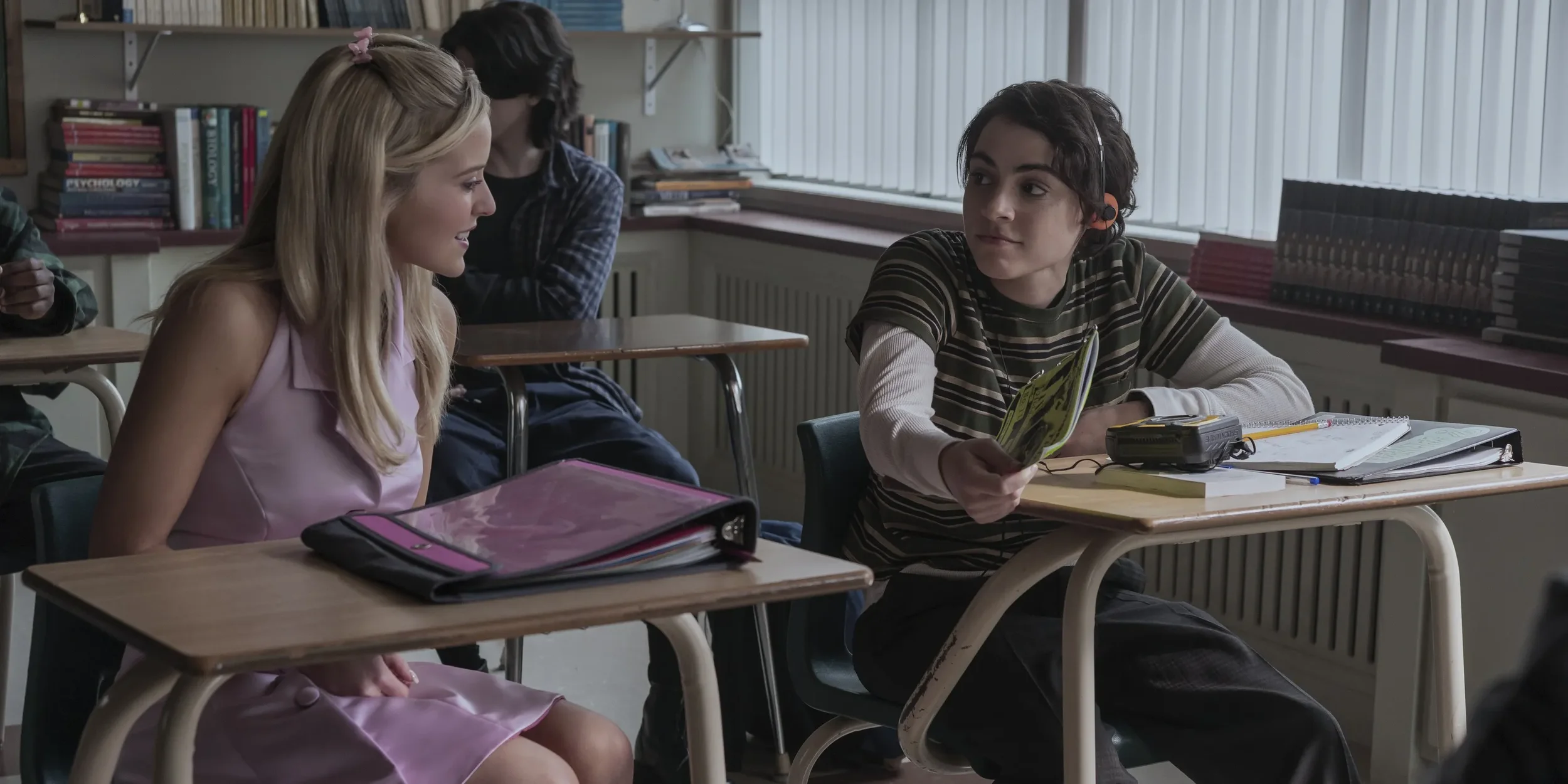
When Elle (Lexi Minetree) moves to Seattle, she befriends Liz (Gabrielle Policano), a witty, androgynous lesbian who makes zines and has a band—HELLO, my dream! Maybe I’m just a sucker for the“ Opposites Attract” trope, but I’m sensing some undeniable chemistry between them. Liz initially can’t make sense of Elle and her bubbly, pinkalicious optimism, but the pair end up becoming quite close. As the season progresses, Liz realizes that Elle’s hyper-femininity doesn’t make her shallow, while Elle discovers that beneath Liz’s sarcastic exterior is a deeply thoughtful and loyal person. Their dynamic is a highlight of the show, but despite my delusions, their connection at present certainly leans more on the air of friendship. Elle has two male love interests, and Liz’s“ actual” romance is with mean girl Kimberly (Chandler Kinney).
Kimberly and Liz share a secret summer fling off-screen that neither wants to acknowledge, and this awkwardness is built up all season long, ultimately culminating in a backstage kiss on-screen. However, Kinney revealed in an interview with Gold Derby that it was actually a bit difficult to convey that hookup without having acted it prior:“ [Policano and I] put in as many charged looks as we could throughout the season, but it’s tricky to have the pressure of that and not have as much build up face to face.” In contrast, Liz and Elle’s chemistry feels very organic, accidental but real. Fans have taken to editing their cheeky moments together, and it’s all over my FYP. While speaking with Elite Daily, Policano shared her honest thoughts about the ship:“ It is not in the text that Elle and Liz have a romantic vibe, but I think I unintentionally may have given the impression that I’m in love with her. Every time I thought I was looking at her with wry amusement and endearingness, I was looking at her [in a flirty way]. Watching it back, I was like,‘ My storytelling was really interesting here.’”
Interesting is right! In that same interview Policano not only supported the interpretation but joked about adding Liz to Elle’s existing love triangle, therefore turning it into a love square. It’s clearly a playful comment rather than a confirmation, but if the series were to take that route, Elle would be canonically bisexual—a development that fundamentally reshapes one of pop culture’s most recognizable heroines.
While ever-positive Elle Woods has never been an outwardly queer character, she is widely celebrated as a queer icon. I don’t know if it’s her sparkly pink pumps or fierce authenticity that resonates so much with our community, but either way the gays love her. TBH, Elle totally gives me bi fem vibes, especially in this newest iteration, and I would be more than thrilled to see something develop between her and Liz. Drama would ensue, and yes, Kimberly would be heartbroken, but the tension MUST BE ADDRESSED!
If the show embraces a queer storyline for Elle, I’d love to see it unfold as a slow burn. Picture Liz and Kimberly officially dating at the start of season two, only to realize that maintaining a relationship is harder than starting one. Thankfully, their problems wouldn’t have to revolve around the homophobia that so many queer stories set in the‘ 90s rely on. One of the most refreshing things about Elle is that queerness simply exists in its world. Liz is openly out, and the show’s LGBTQ+ characters aren’t defined by discrimination or forced into coming-out narratives. While homophobia undoubtedly exists, it doesn’t need to be the engine driving every queer storyline. Instead, the conflict could be entirely interpersonal. Kimberly might begin noticing how naturally Liz and Elle connect, growing increasingly insecure about the emotional intimacy between them. At the same time, Elle herself could begin questioning feelings she has never allowed herself to examine before. Rather than immediately realizing she’s bisexual, she might spend much of the season wrestling with the possibility that her attraction to people isn’t as straightforward as she always assumed. One thing will lead to another, Kimberly will end things with Liz, and newly out Elle will swoop in (perhaps in a third season, to really give viewers that classic slow burn).
Of course, introducing a romance between Elle and Liz raises the question of continuity. Fans of the original Legally Blonde films know that Elle eventually falls in love with—and, by the second film, marries—Emmett, a cisgender straight man. On its own, that isn’t a contradiction. Bisexuality has never required equal attraction to multiple genders, nor does ending up with a man somehow invalidate a bisexual woman’s identity. Plenty of bisexual people are in different-gender relationships, and their sexuality remains just as real.
That said, it’s understandable why some queer viewers might be skeptical. Hollywood has a long history of minimizing or erasing queer identities, particularly under the Motion Picture Production Code (better known as the Hays Code) which governed American filmmaking from the 1930s through the 1960s. The Code prohibited the positive depiction of“ sexual perversion”, and as a result, openly queer characters were effectively banned from mainstream films. Writers had to rely on subtext and coding, and many characters with queer traits were ultimately paired with opposite-sex partners, punished, or killed by the story’s conclusion to reinforce heterosexual norms. Although the Hays Code itself is long gone, its legacy still shapes how many audiences engage with queer representation. Decades of queer-coded characters ending up in heterosexual relationships have understandably made viewers wary of narratives that appear to“ correct” or erase queerness by the final act.
For that reason, if Elle were to make its heroine canonically bisexual, the writers would need to be intentional. A relationship with Liz couldn’t simply be framed as mere experimentation before Elle returns to the romantic trajectory established by the films. Instead, the series would need to affirm that bisexuality is an enduring part of Elle’s identity, regardless of who she ultimately ends up with. Even if her relationship with Liz doesn’t last forever—as most high school romances don’t—it should remain a meaningful chapter in her life rather than a phase she outgrows.
As a reminder, this is all purely speculative. There’s no proof that the writers are planning to rewrite Elle Woods’ sexuality, but the possibility of bi Elle is certainly more likely than ever! I, for one, am rooting for it.