Not Your Token: Harini on Identity, Fusion Dance, and Brown Queer Representation
Written by Daphne Bryant
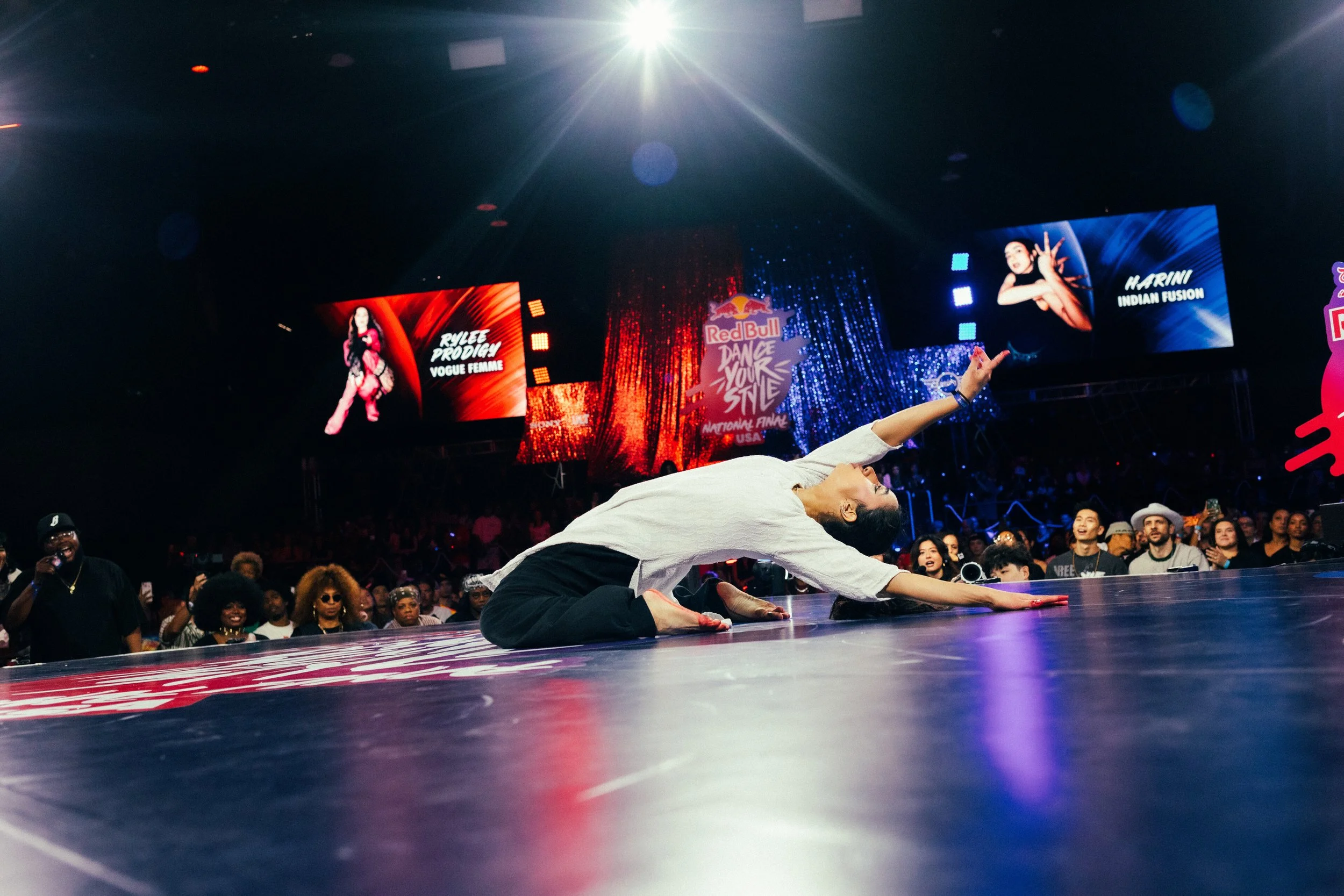
Image courtesy of Marina Oya / Red Bull Dance
Harini Nilakantan (she/they) knows how to make a statement. Originally from Chennai, India and based in Chicago, Illinois, the 27-year old dancer and artist draws inspiration from her dual cultural roots and diverse movement background, to fuse the dynamics of street dance styles such as waacking and hip hop with rich Indian dance traditions—notably Bharatanatyam. Her vibrant moves and infectious spirit earned her a spot in the final eight at Red Bull Dance Your Style’s National Final, but before she graced the stage Dreamworldgirl Zine scored a very special interview.
Naturally, we kicked things off by chatting about astrology.
Daphne: Do you know your zodiac sign?
Harini: Sagittarius!
Daphne: AH! Okay, I’m a Sag rising.
Harini: I’m a triple Sag BTW.
Daphne: What?! Oh my gosh. You’re a Sag through and through. SAG DOWN!
Harini: Imagine my life right now…
Daphne: I’m like, that’s a lot of fire! But I love Sagittarius, that is such a fun sign. Shall we hop into the interview?
Harini: Yes!
Daphne: Let’s talk about your style and the fact that it’s this really cool fusion of traditional Indian dance and street dance. Where do you kind of see the connection between the two? How do you meld them?
Harini: A lot of my inspiration comes from the shilpas, or sculptures, that are in Indian temples. I want [my dancing] to [feel] like one of those temples coming to life. So similar to waacking and voguing, you have poses [and] it’s picturesque. Both styles are very picturesque, and those are my main styles that I fuse. That’s where I saw the connection.
Daphne: Hell yeah.
“It’s almost like an exchange happening in real time between the styles. Rather than trying to absorb one or the other, I want [it] to feel like a mosaic, less like a melting pot.”
Harini: Does that make sense?
Daphne: Yes it makes complete sense! And I heard you were a wild card pick for the final?
Harini: Yes I am!
Daphne: Congratulations! That means the crowd fucks with you! Going into the battle, what are you most looking forward to?
Harini: I am really, really, really looking forward to the exchanges.‘ Cause if you’ve seen the lineup for [the final]...
Daphne: Insanity!
Harini: We have troves of talent and some of them are my favorite dancers, so I really want to get on the floor [and] give my best to them, and then receive their energy and put on a good show. That’s the most honest answer I can give. I’m also looking forward to seeing what my body can do. Hans will pull out some great tracks. I don’t know what I’m gonna get, and I don’t know what’s gonna happen in the moment. So I’m excited for myself, too, to see what I’m gonna do.
Daphne: Yeah, I think that’s one of the coolest parts about freestyling and the format, you really get to challenge yourself. How do you prepare for things like the Dance Your Style National Final?
Harini: Mentally, I don’t want to psych myself out. I want to relax. I have a healthy dose of nervousness, I can’t lie. Look at the lineup! So I want to take [those] healthy nerves and then channel it into good energy, [as well as] take care of my body. Physically, though, I go back to my basics. I like going back to fundamentals, practicing my foundations every day and the basics of Bharatanatyam, just to make sure I’m strong and [that] what I’m doing is readable.
“I throw rounds against myself. So I’ll have player one in a different suit and player two in a different suit, seeing how I respond to myself in different parts of the dance. I treat it like a video game.”
Daphne: That is so cool! What a fun way to look at it. And how do you bring out your fashion when you dance?
“I try to have at least one element of Indian clothing, [such as a] dhoti which is a billowy pant that we wear. Last time, I draped a sari, because that’s how we usually do it, and I did it in a kacche drape. Kaksha means to protect, so it was the type of sari that women used to wear for every activity. War, dance, farming, it would be anything. So I wanted to represent that.”
Harini: This time, I’m going with something a little bit more casual, [but] whenever I’m on [stage], I try to fuse both elements of the street styles and the Indian styles. I dance barefoot, sometimes I paint my feet to give homage to the classical dancers. My jewelry is very Indian, so [they’re] like little bits of home that I always have with me. I always have a bindi on. But sometimes, [I’ll have on] a tight fitting mesh top, or a tight fitting shirt to help my waacking moves be more readable, and that’s a little bit more, like, tech wear. If I’m in a fully street dance outfit, like baggy pants and [a] tight shirt, then I’ll try to layer a dupatta on top of it. So I always bring an element of my own everyday dress from India.
Daphne: I love it! What are your favorite colors to wear on yourself?
Harini: Red! I mean, I have three Sagittarius placements.
Daphne: Of course, you know what? I should have known.
Harini: Red calls to me. If you’ve seen my headshot and that very bright red—
Daphne: Oh, I know.
Harini: I love red and white on me these days actually, just to cool it off—‘ cause I’m in love with the moon. Something very fiery or something very mellow, to balance myself.
Daphne: I’m sensing that balance is important for you! And I have to say, I think you’re very inspiring! Not just for brown representation but also queer representation. I was so excited to speak with you. What does representation mean for you, personally, and why do you think it’s important for people to see themselves on stages like Dance Your Style?
“Representation opens so many doors for us, and it breaks down a lot of insecurities we grow up with, especially as people of color. When we look at something on the screen, and we don’t see someone who looks like us, we think: there’s no [chance] that I would make it there. This is the standard, I’m a deviant from that standard. They’re not gonna take me, ‘cause I’m an anomaly. I don’t fit. So, when you see representation, no matter how small or big, you think: ‘Okay, I have a chance!’ Representation can unlock so many things for people who normally aren’t represented.”
Harini: Unfortunately, society has [made it so] that you have a certain norm and [people] “ outside of the norm.” That’s why you have the“ normal” versus the people of color differentiation, and you have straight and heteronormative, and then you have homosexual. The fact that [society] created a normal to separate from alt culture…that itself [tell us] that [we] need representation to bring back that balance. It became so skewed, right?
If I [saw] myself in dance, I didn’t see Indian classical dance done.
Daphne: Me neither!
Harini: I didn’t see Indian folk done, either. I saw capoeira, I saw other styles, shout out and kudos, but then I never saw a Desi person be like:‘ Hey, these beats sound similar [to the] beats that we dance to back home.’ Why can’t I go showcase that? You see elements of it in the Indian competitors [of] Red Bull India, but then they’re still street dancers. And they’re very talented, but it’s not like I see that as a core style being used and manipulated.
“There’s a lot of fear and stigma on our side, too. We don’t want to dilute the dance. We don’t want to go up there and throw around and insult the dance accidentally. There’s a lot of fear. So when I go up there, I’m slowly trying to weed away that fear, and then show another girl that looks like me or another guy that does my dance style, or nonbinary person [that it’s possible]. Like, I want to see someone brown doing a brown style!”
Harini: If they see that I did it, and I got to where I am right now, hopefully further, that’s a huge thing, you know? I don’t want to be the only one.
Daphne: Right, you don’t want to be a token.
Harini: I don’t want to be a token! And you know, being a pioneer…I love the fact that I can open up doors for other people, but I don’t want to be lonely. There’s so many of us. I was just talking to someone outside about the same thing!
“Everyone here has a reference point for ourselves. I will become the reference point for someone else’s style.”
Harini: I want to make sure that I’m doing good and that I’m not a bad reference point.
Daphne: You’re not a bad reference point, you’re so awesome.
Harini: Thank you!
Daphne: You’re killing it, that was such a beautiful answer. Thank you for sharing.
Harini: Of course.
Daphne: Okay, fun question for you. What are some of your favorite songs, artists, or genres to listen to when you’re training specifically?
Harini: Tyla is amazing to train to!
Daphne: My queen!
Harini: Genuinely, what she’s doing with Amapiano music?
Daphne: Uh huh.
Harini: And her vocals? It’s fun to train to Tyla! Any kind of amapiano beats, right? The way the log drums are used, it can really push you to see what you can do. So that’s one answer. The other one…I listen to a lot of emo music.
Daphne: Ooooh.
Harini: I am not kidding.
Daphne: When you say emo music, what are we…
Harini: Pierce the Veil.
Daphne: Pierce the Veil. Any MCR?
Harini: Oh for sure, come on! Of course MCR, but, like, Pierce the Veil has a diverse selection of songs.
“My favorite all time go-to song to train to is ‘Bulls in the Bronx.’ Because that track goes up, down, everywhere, right? And then ‘Bring Me the Horizon.’ And there’s a song called ‘Doomed.’ by Bring Me the Horizon - Incredible song.”
Harini: Fallout Boy, Chicago represent! Paramore?!
Daphne: Yeah!
Harini: It’s not typical but…Afro dance, Afrobeats, and all of the, you know, traditional West African beats are very similar to Indian kuthu beats. [I train] with a lot of percussive music. I listen to a lot of Papa Wemba, I listen to Carlos Santana, Michael Jackson, Janet Jackson, and then [on] the Indian side, I’m listening to lots of A.R. Rahman, lots of, you know, Rhea Raj, Priya Raghu, Paal Dabba, new indie artists that are coming up. I listen to a lot of house music. Film music, Bollywood music. I don’t stop! Anything at all. But [for sure some] favorites: 2000s Bollywood, 2010s Tamil music, and Tyla.
Daphne: I love it. Dream blunt rotation.
Harini: You can do so much with that.
Daphne: That was fun, now I have recs!
Harini: I yapped your ear off.
Daphne: No, that’s literally why I ask, I’m genuinely curious about what you’re listening to. Okay last question, and we kind of talked about this earlier with the representation question, but are there any doors you want to open for yourself within the dance community?
Harini: I have a lot of dreams.
Daphne: Let’s hear it!
Harini: I’m blessedly in [a lot of] different spaces at the same time. I’m [an] Indian classical dancer, so I get to do those performances, you know, temple performances, stage performances with Kalapriya, my place of work. Shout out, Kalapriya. Thank you for supporting me. And, I’m working with A.R. Rahman right now, on his symphony tour, so I danced with him, and he’s a huge name. I love him. He’s my childhood hero. And we’re working in the symphony side of things, where, you know, Indian classical dances aren’t necessarily what you’d see in the symphony. You would see a lot of ballet, a lot of modern, but then I’m bringing in the beauty of Indian classical dance, and that fusion to symphony spaces. And we have this same dance style done in freestyle spaces, with street dance, and then I was in the competition sphere for a while, with the World of Dance. Shout out to them, too. So I get to use this style so malleably. I would love to do more music videos, industry work, you know, put myself out there, and make cool visuals. I would love to do that. I would love to do that with this style and see where it takes me, and work with other South Asian pop stars.
“I know I say South Asian, because, you know, there’s eight countries. I am representing quite a lot of us, but specifically for my home country, India. I would love to go back and work with a lot more fusion artists, Desi artists, indie artists, put our minds together, create a visualizer, put something on wax, make some physical media. I just want to continue doing what I’m doing [on] a larger scale.”