I Promise I Wanted to Like Forbidden Fruits
Written by Leah (Bunny) Overstreet
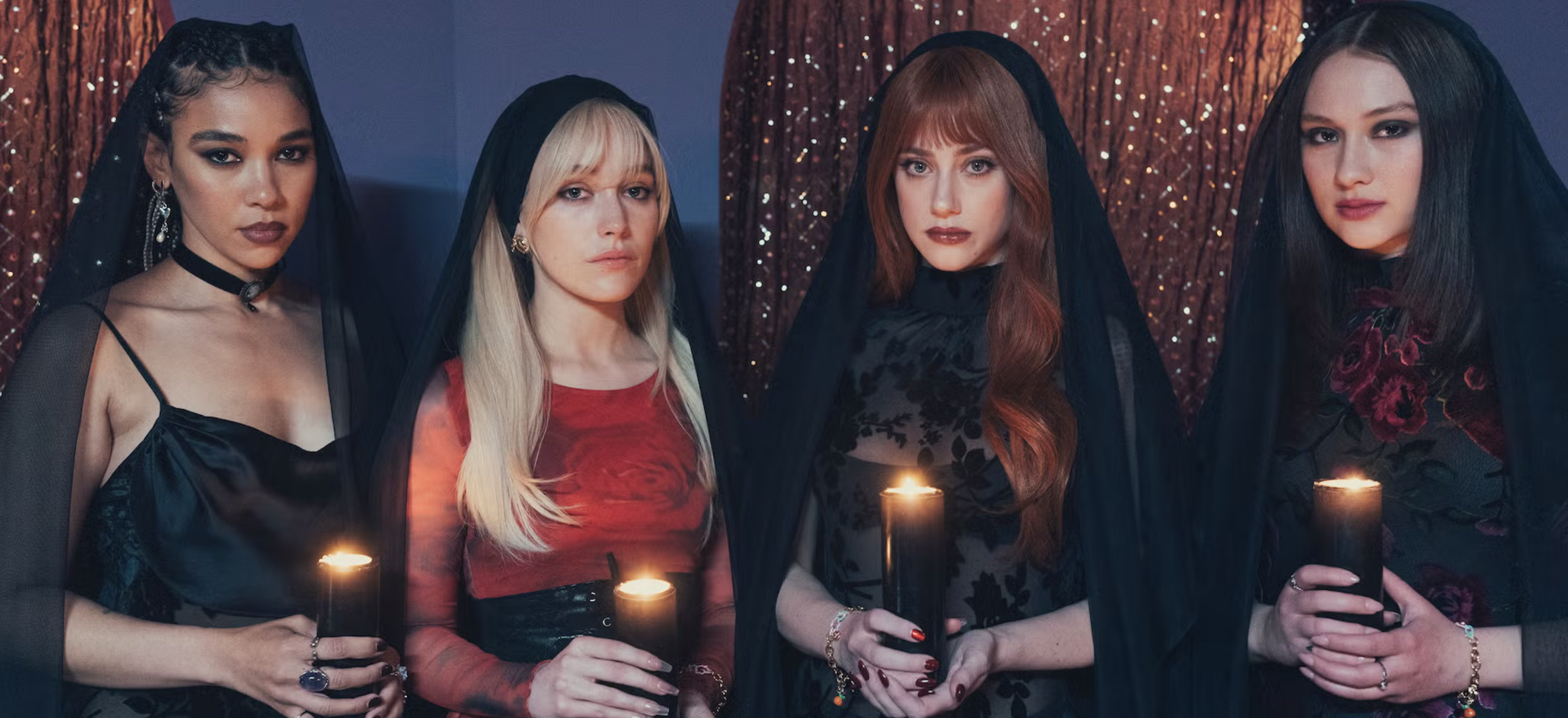
Image courtesy of Sabrina Lantos
WARNING: SPOILERS, DIVA!
It started out so strong, boldly set in the exact kind of mall I grew up strutting around and swapping glossed gossip in. Forbidden Fruits pulled me into a world of sinister sisterhood, uncanny and catty. It featured beautiful girls giggling over rituals, wringing out their panties into a bejeweled cowgirl boot, and placing sequins on their tongues like girly ecstasy (no drugs necessary). I was the exact kind of girl this movie was made for… or so I thought.
As the movie progressed and the visual novelty wore off, I noticed that the dialogue felt clunky and forced, the references fell flat, and the lesbian coded character (which drew me to the film in the first place) was made the villain, her lesbianism positioned as the source of her evil.
The character of Apple (played by Lili Reinhart) is heavily coded as a femme lesbian. She never shows an interest in men, maintains homoerotic vibes with the other girls, is jealous and disapproving of them dating or sleeping with men, has two notably short nails along her acrylics, and even (spoiler!) kisses Cherry (played by Victoria Pedretti). Some of these obviously queer elements are part of what got myself and other sapphics I know excited to watch this movie in the first place. My boygirlfriend and I were cuddled on the couch, eager to watch what we assumed would become a cult classic only to be perplexed by what appeared to be an oddly anti-lesbian plot line? Honestly, Forbidden Fruits went beyond merely coding a villain as queer (tale as old as time). Apple’s villainy seemed to be directly linked to her queerness; most notably, in the way she controlled and policed the girls working at“ Free Eden.”. She forbids the coven from having boyfriends, demanding they only communicate with men via emojis, or only hook up with them on specific days of the week. Apple even places a deadly hex on Pickle (played by Emma Chamberlain) just for having a boyfriend. Her hatred of their relationships with men places her and the paradise of sisterhood she creates in direct opposition to men. This left me heavily side eyeing the screen. I wondered why a movie I went into excited for intense, potentially witchy, and (fingers crossed) homoerotic friendship between women had a literal man-hating lesbian (with daddy issues) as the antagonist who kept the women of the movie from the one thing they can’t live without: boys boys boys!
What’s more, there doesn’t even seem to be a clear example of non-toxic friendship between women and instead, the movie rounds out with Apple encountering a different coven-like friend group at a different mall. This group just so happens to work at a different Free Eden with the same toxic hierarchy in place.
Several characters also mentioned struggling to make friends with women, previously having toxic female friendships, and the events of the movie only further confirm their suspicion that women are difficult, conniving, and vengeful. It goes beyond villainizing lesbians and seems to disavow the concept of female friendship entirely. What a strange direction to take this movie in. Not only did it feel anti girl group, it also felt strangely disparaging of femininity.
“It goes beyond villainizing lesbians and seems to disavow the concept of female friendship entirely. What a strange direction to take this movie in. Not only did it feel anti girl group, it also felt strangely disparaging of femininity.”
Forbidden Fruits paints a contradictory portrait of girlhood, one that seemingly revels in a frivolous campy femininity yet also wishes to punish and villainize it. It showcases a girlhood that I found unrecognizable at times. The girls confess their sins to Marilyn Monroe, geek out over Ed Sheeran concert tickets, and refer to Barbie as the“ ultimate girl boss.” These references, to me, felt out of place and not accurate to Gen Z girls. I had to consider if, as a 23 year old Black lesbian, I might not be the intended audience at all, and if this movie was actually written for heterosexual, millennial white women. Although I’m even unsure of that because it still felt off, almost like an unfavorable caricature of femininity.
Beyond that, I also feel like the dynamics of the coven could’ve been more thoroughly explored. It didn’t feel like we, as an audience, ever got to truly fall in love with the idea of“ paradise” that ensnares both Fig (played by Alexandra Shipp) and Cherry so completely. A book that reminds me so much of this movie is Bunny by Mona Awad, but the entire concept was done so much better. The book, like Forbidden Fruits, features a group of hyper-feminine women embracing“ sisterhood” with a little side of witchcraft, and it is also led by a harsh yet beautiful queen bee who welcomes an outsider into their midst. I feel like what Bunny did really well was showcase the main character’s shift from suspicion to fully losing herself in this world. With Forbidden Fruits I wanted to drink the Kool-Aid, guzzle it even! It would’ve been so fun to watch Pumpkin (played by Lola Tung) fall under their spell. Instead, it felt like Pumpkin, and the audience by extension, were made to hold Apple and her disciples at an arms length, never truly allowing them to feel human. I think this could’ve worked better if maybe the movie leaned further into the campy elements that I believe were the best part of the movie overall. I think this is especially true of the over-the-top gore elements that came in towards the end: the glass splitting Fig straight down the middle, Cherry being chewed up by the escalator, ripping out acrylics with blood gushing flair. This was the full send I’d been waiting for the entire movie. It was absolutely ridiculous but it was sort of what the movie needed.
Overall I wanted a lot more from Forbidden Fruits. It could have been the toxic yuri hyper-femme slasher of my dreams if only more care had been taken with the kind of message it was putting out (even if unintentionally). There seem to be a lot of cool ideas thrown together without much care as to how they would come off as a collective. Girl coven? Fab! Toxic friendships? Fab! Man hating lesbian? Fab! Putting boys in direct competition with female friendship and having them win???? Now that’s just killing the vibe. The girls could have just as easily been pulled away by a superior (actually supportive) group of gal pals. Instead, Apple’s jealousy of the men in her friend’s lives is made to be an over the top extension of her already evil and controlling personality. Dare I say, the jealous and controlling lesbian out to get your boyfriend is a tad over done and, frankly, a surprising direction to take such a promising concept. Especially in an era that celebrates and prioritizes“ girls supporting girls” (something that is directly mocked in the movie btw) and decentering men, it feels like the writers lost sight of what their audience wants to see. Or rather, the audience they had in mind with their messaging seems to be at odds with the one they pulled in.
“Especially in an era that celebrates and prioritizes “girls supporting girls” (something that is directly mocked in the movie btw) and decentering men, it feels like the writers lost sight of what their audience wants to see. Or rather, the audience they had in mind with their messaging seems to be at odds with the one they pulled in.”