Dreaming of a Better Ending: Why The Stranger Things’ Fandom Birthed Conformity Gate
Written by Daphne Bryant
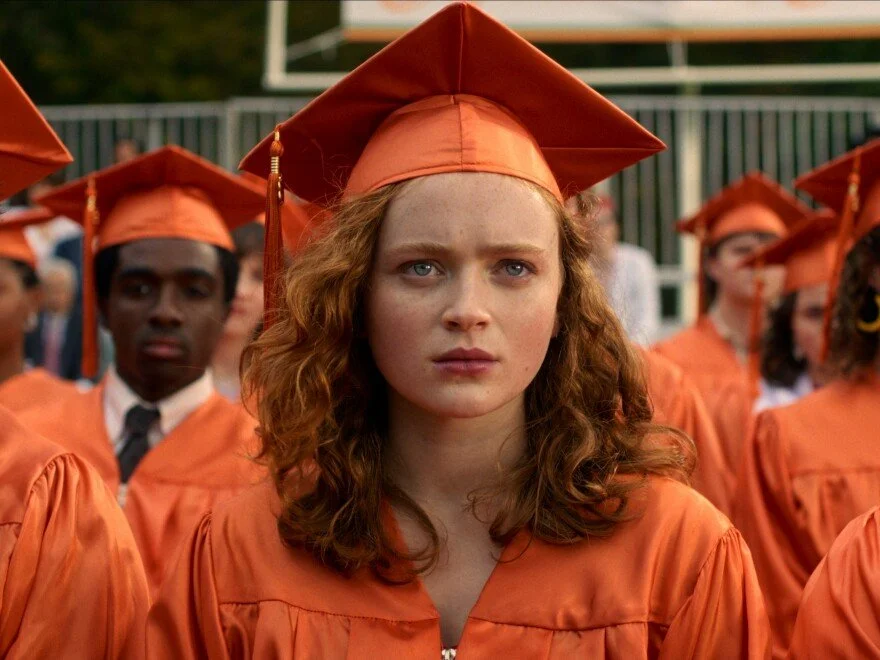
Image courtesy of Netflix
A series finale so universally hated it caused a mass psychosis within its fanbase: Stranger Things, I mourn you.
Like many Gen Z nerds, I grew up with Stranger Things. It was a show I watched with my entire family in our living room, eyes glued to the television as we did our collective best to understand the Upside Down and associated phenomena. The franchise was never perfect, but there’s just something about it that resonated. Over the past decade, Stranger Things has brought in over 1.2 billion total views, officially cementing it as one of the most successful streaming shows in history. The series combined 1980s nostalgia with spine-chilling storylines and multi-generational humor, paying homage to classic horror films and thriller tropes while offering up something fresh and exciting. Once you start watching, it’s hard to stop.
There was a three-and-a-half-year gap in between the releases of Season 4 and the final Season 5, so trust me when I say the series’ end was highly anticipated. Everyone had their own personal hopes and desires for the franchise; personally, all I really wanted was to see Nancy (Natalia Dwyer) and Robin (Maya Hawke) kiss and do gay stuff together. Wish not granted (unless you count that sapphic Emerson College joke), but that’s a story for another time.
When the first episode of S5,“ The Crawl”, came out, my younger siblings and I huddled together in our great-aunt’s basement to watch. I’m pretty sure we binged the first installment in less than 48 hours, and while I was super excited to be there and for the most part pleased with episodes 1-4, my brother was absolutely not having it. He seemed largely disinterested and irritated by the plot, dialogue, overall acting, and cinematographic choices. I’d often catch him doomscrolling during important moments or scoffing at the screen, and his positive commentary and reactions were subpar at best (this is unlike him as my brother can be a very dramatic and animated person). He was so out of it that I assumed he’d secretly watched everything without us; what other explanation was there for a lover of Stranger Things to be so apathetic and so bored?
Online, fans shared similar sentiments. Backlash revolved mostly around weak writing and an odd shift in tone. Viewers widely mocked the script for its cringy lines and the delivery of them, part of which was politely attributed to the main cast aging out of their roles as high school“ kids.” For example, Millie Bobby Brown who plays El is a mother now, and Caleb McLaughlin who plays Lucas will be turning 25 this year. When the writing is bad, it can feel especially awkward coming out of a grown adult’s mouth.
Speaking of characters and their hollow character dynamics, the forced revival of washed-up romantic triangles—such as the one between Nancy, Jonathan (Charlie Heaton) and Steve (Joe Keery)—was another point of audience contention; people were frustrated with the re-emergence of cheesy tropes that they’d outgrown. Fans also looked down upon the complete lack of stakes, as multiple major characters constantly survived extreme danger without so much as a scratch, and other major characters suffered extreme violence for stupid reasons that served no real benefit to the plot (I’m looking at you Dustin in the graveyard scene).
Okay so, maybe the first half of S5 had some issues, but even with all the critique, there was still hope amongst the community. Stranger Things superfans and critics alike laid out everything that needed to be done in order to resolve plot holes and wrap the show up in a way that’d be satisfying for viewers. They placed faith in the Duffer Brothers to give us an ending worth waiting years for. I myself was eager to see how it all panned out.
Well.
The rest of S5 came out on New Year’s Eve, and everything went to shit. So much happens in the second half, so I’ll fast-forward to the final episode“ The Rightside Up”, where each main character is shown living unusually happy lives, despite all the trauma and bullshit they’ve been through. Lucas and Max (Sadie Sink), who have historically had a tumultuous, on-again, off-again relationship, are still together. Dustin (Gaten Matarazzo) is thriving in college and regularly hangs out with Steve. Will (Noah Schnapp) lives in New York City and has a boyfriend who is noticeably not Mike (Finn Wolfhard), his long-time crush that the Duffer Brothers have been hinting at since Season 1. Even Mike and El, who arguably have more ambiguous endings completely separate from one another, are carving their own paths, writing their own stories, and content to do so. While the show’s conclusion seemed a little sugary to me, and I had gripes unrelated to the Dungeons and Dragons scene in Hawkins, I still cried and fangirled over it. I was ultimately unbothered by the season’s flaws, until I hopped on TikTok and stumbled upon what fans have dubbed Conformity Gate.
Conformity Gate, in this context, is the theory that the finale we all watched is not real, some kind of alternate, carefully manufactured ending. It’s contingent on the idea that Stranger Things (a show previously unafraid to kill off beloved characters and show extreme gore) would never wrap up in such a frictionless, conformist way. To be honest, I understood the theory and its virality as soon as I discovered it.
Everyone in the main cast graduates and is mentally sane. Will the hopeless romantic actually falls in love. And El is like…not dead. Rather, she’s pictured backpacking in gorgeous European-looking hills. Everyone is just dandy, even the older castmates! For all the anti-conformist notions and themes presented within the show, there sure is a lot of conformity in the finale.If you’re like me, you’ll understand why this merry ending did not go over well with fans, and why they were quick to question it.
The Conformity Gate theory additionally proposes that there is one more“ hidden” episode left, a“ proper” and darker ending that would’ve been strategically dropped in January, days after the show’s supposed fake end.
What’s craziest about this theory is that it isn’t actually so crazy. Look it up: there are lengthy TikTok videos, elaborate Reddit threads and more-than-convincing edits that back up nearly all Conformity Gate truthers and their suspicions. In most theories, the ending is an illusion created by Vecna/Henry Creel (Jamie Campbell Bower), the show’s primary big bad. Vecna can craft entire worlds and hallucinations out of thin air, so it’s not insane to think that he somehow survived and now has all of Hawkins suspended in his little mind game. A very recent example of this exact trope is Marvel’s Wandavision, where Wanda, unable to accept the death of her lover, unconsciously uses her immense“ Chaos Magic” to rewrite reality. She takes over a suburban New Jersey town called Westview and traps hundreds of innocent residents in a sit-com style illusion. This is not unlike what Vecna does in the Conformity Gate theory (except his takeover is certainly implied to be conscious and malicious).
I’ll admit it: I fell for Conformity Gate. I got so wrapped up in the mutual outrage and passion that I genuinely believed that the Duffer Brothers might be pulling our leg. I thought, perhaps everybody is right. Perhaps the Duffers are mad geniuses, toying with us the way that Vecna has been toying with these kids. But alas, a ninth episode never materialized. Stranger Things as we know it is over, and there is no conformist scheme or plot twist, just really, really mediocre writing.
More theories abound as to why the Duffer Brothers fumbled. Some think they simply got lazy: they have been known to make silly mistakes or forget core details of their show, and were caught using Chat GPT in the S5 writer’s room. Speaking of the writer’s room, revealing clips were released in a Netflix documentary about Stranger Things, and in them the Duffer Brothers are heard actively ignoring other writers who brought up valid questions about the logistics of the finale. Perhaps there was this sense of entitlement on set too, an entitlement that prevented the show from achieving its full potential. One of the most common theories is that Ross Duffer’s talented ex-wife Leigh Janiak (who directed the very queer and popular Fear Street trilogy), was actually ghost-writing for them, and that the show simply declined in quality when she left him in 2024. I wouldn’t be shocked if this was the case. Throughout history men have stolen amazing scripts from their girlfriends and wives, and we know that Janiak can direct a successful horror franchise with complex queer characters. On the flip side of the spectrum, the Duffers had Will come out in front of a huge group of people, including near strangers, and butchered Robin’s relationship with Vickie (Amybeth McNulty), who by the way, was originally written to be a butch. RIP butch Vickie and masc4masc in the mainstream! You know who wouldn’t have let this slide…? Janiak.
Mystery aside, after the finale was released the Duffer Brothers went on a damning run of press interviews that clearly demonstrated their unstable state and anxiety about reactions to the show. They bumbled horribly through demanding questions and seemed to mock themselves, aware of insurmountable hate from a devout fandom who were beyond disappointed. It just sort of feels like the Duffer Brothers gave up on Stranger Things; the cultural phenomenon and coping mechanism that is Conformity Gate was proof of that. Even the actors despised the ending, going so far as to say on public broadcast that the fans were“ better writers than the Duffer[s].” And shit, I think we are! Conformity Gate was a rare conspiracy theory, one that genuinely made sense, captivated global viewers, and shed light on what could have been the greatest finale of all time.