Written by Gianna Di Cristo
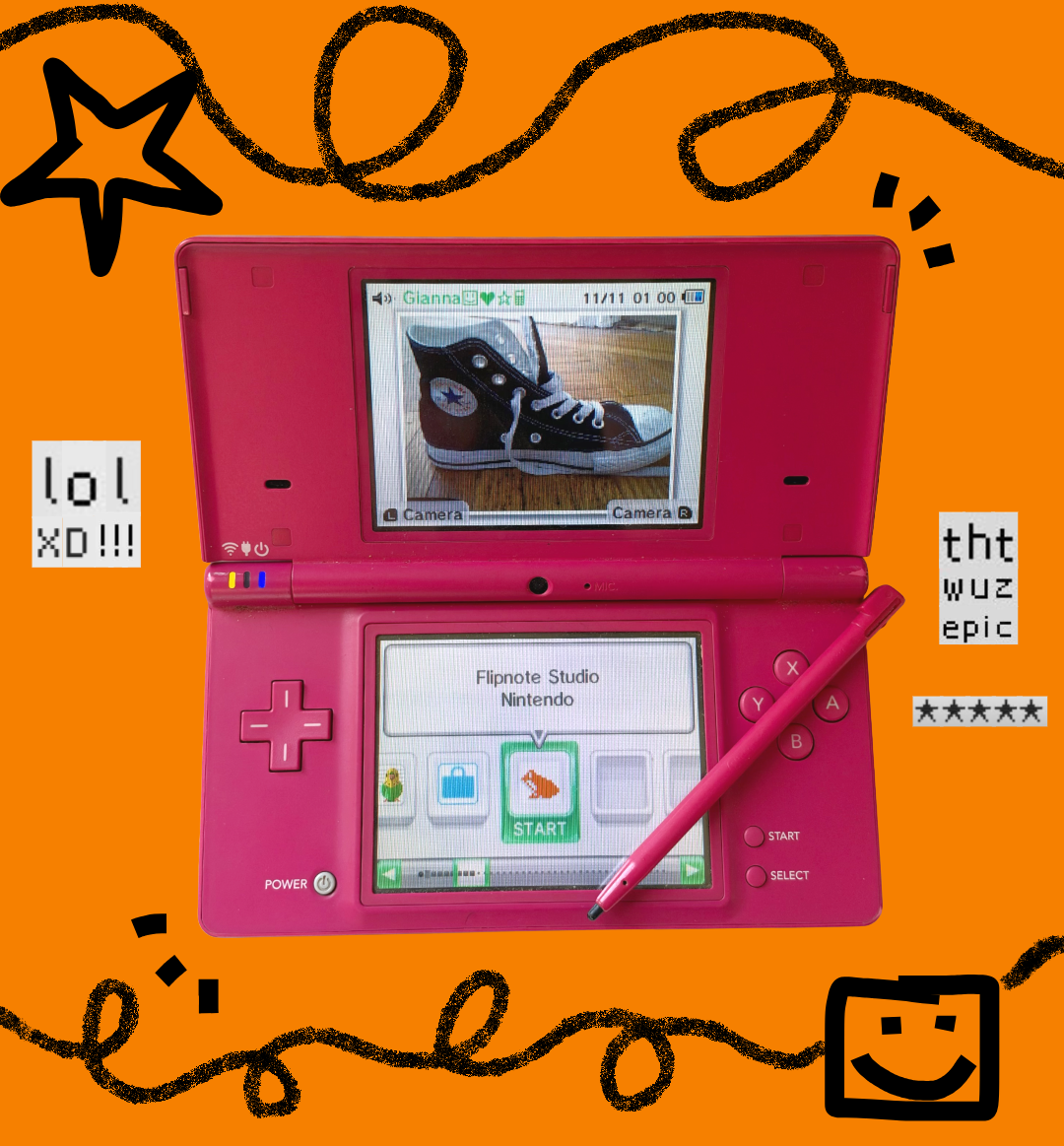
I was 8 years old when I got my Nintendo DSi. It was released in the US in April 2009, and I had the joy of ripping it open on Christmas Day that same year. To my dismay, my mom had gotten my sister and I matching hot pink ones (I was not a pink girl growing up, and had begged for the turquoise one). However, that disappointment didn’t last very long because now, I had a DS with a camera, voice memos, and access to the internet. Growing up in the early 2000s makes me a digital native. I have been on the internet playing games since I was 5 years old and watching YouTube videos since I was seven. I’ve always been into the arts. I grew up in my grandpa’s house where his own paintings and drawings lined the walls. He painted ducks, a matador with his bull, landscapes of Long Island, and some abstract pieces. There were always stacks of computer paper, markers, crayons, and paint in his dining room cabinet for us to use and play with whenever we wanted. Like any other kid, I loved cartoons, and always enjoyed when channels like Nickelodeon would show a breakdown of how to draw and animate characters like Timmy Turner from Fairy Oddparents. Seeing adults being cartoonists and making funny art was always so fascinating to me. But from my childlike understanding, only people who were lucky and handpicked by commercial networks could make it big. That’s when Flipnote Hatena came in and flipped my worldview.
Before having iFunny on my iPod Touch, the Nintendo DSi was my first exposure to meme culture and digital arts. Flipnote Hatena was an animation app on the console, and its intuitive controls made it easy for someone to experiment with animation. Some users made stick figure art and others went all out, drawing and shading more complicated cartoon styles with only a few colors: black, white, blue, and red. You were able to record audio and insert it, as well as take pictures and convert them into sketches.
For hours I’d sit on my grandpa’s couch with his Walkman headphones connected to my DSi and watch stick figure art that was being animated by kids not much older than me. This was the first platform on the internet that had me scrolling for hours. I remember the homescreen of Flipnote was similar to what YouTube is now: Highly rated Flipnotes, Recommended Flipnotes, your favorites, and new uploads. Flipnotes were rated by Stars rather than likes and were sorted that way. I’d sit there and giggle for hours. It felt like this was a platform made for creative kids like me.
The stencil of Luigi’s face, known as The Weegee, became a jumpscare on Flipnote Hatena. Another“ creepy” Flipnote included an omniscient Elmo. The creepy Flipnotes were ones I didn’t seek out too much considering I was very easy to scare as a kid. If I had unknowingly come across an unsettling Flipnote of similar content, I’d immediately go to cleanse with anything else on the page. Sometimes it’d lead me to users who would also animate to standup routine audios like Cup of Dirt from comedian Brian Regan. This platform was the first exposure I had to a classic: The Super Awesome Face. I doodled this everywhere after seeing it for the first time. My favorite amongst the SAF Flipnotes includes the one mimicking a scene from Night at The Roxbury. In pure 2000s fashion, even the kids were farming for likes back in the day by weaponizing hate for Justin Bieber.
Flipnote Hatena was also a platform that exposed me to an early version of fan edits. There’s this Flipnote of Blaze and Silver from Sonic The Hedgehog Series lip syncing to Everytime We Touch by Cascada that I loved. I remember reading comments like“ silver & blaze 4everr!! ✩♥”
Parodies and animated music videos were amongst my favorites on the platform. As someone who’s also always been in love with the art of music videos, seeing people create what they would imagine in their head, as random as some of them were, fueled my own daydreaming and need to seek out art rendered in this style. The parody of Michael Jackson’s“ Beat It” (“ Eat It”) by Weird Al-Yankovic featuring the main characters of Spongebob Squarepants, and“ Smooth Criminal” (“ Food Criminal”) by a creator named Frank Blankenburg, lip synced by 8-bit Mario, Boo and King Boo singing Do You Like Waffles,” and Shy Guy singing to“ I Ain’t Got No iPhone” became stuck in my head, a true marker of 2000s random-quirky-humor. Other types of Flipnotes that I enjoyed watching include cinematic and inspirational animated music videos (for 8-year-old me) like this one with the Eurodance song“ I Can Walk On Water” by Basshunter.
I remember the following year after getting my DSi, the night before school was starting. My sister and I had snuck ours into bed. My mom came into our room eventually because we couldn’t stop laughing at this rap about Big Macs. I remember laughing so hard there were tears coming out of my eyes, and laughing even harder because of the way my sister was laughing. Hearing a rap about a burger in the cadence of Shaggy would kill me. I woke up the next morning for my first day of fourth grade regretting nothing, just excited to see how my new teachers were and to play in the schoolyard afterwards.
The crunchy audio from the DSi mic gives me chills every time I hear it. I would always imagine other kids like my age at the time, or what I used to call“ big kids” (teenagers) on the other end of my WiFi connection personally showing me their art by posting Flipnotes. I felt connected to other creative kids, despite the lack of actual interaction with others on the platform. This short era of the internet represents a time of innocent comedy and an exciting new way to showcase art. It was simple, creative, and left room for your imagination to run wild. It was accessible for kids and you didn’t need a subscription, you didn’t need to pay money. These animations required time and effort to produce. Sometimes it feels like we’re light years away from this era of comedy and the production of memes (even though there are still artists on YouTube that are reminiscent in style to this era, like oilyFoot65). I miss that era. It’s proof that art doesn’t need to look like a Baroque painting or be elaborately worded or scripted to be considered art.