Lowkey, You Chose To Get Cancelled
Written by Leah (Bunny) Overstreet
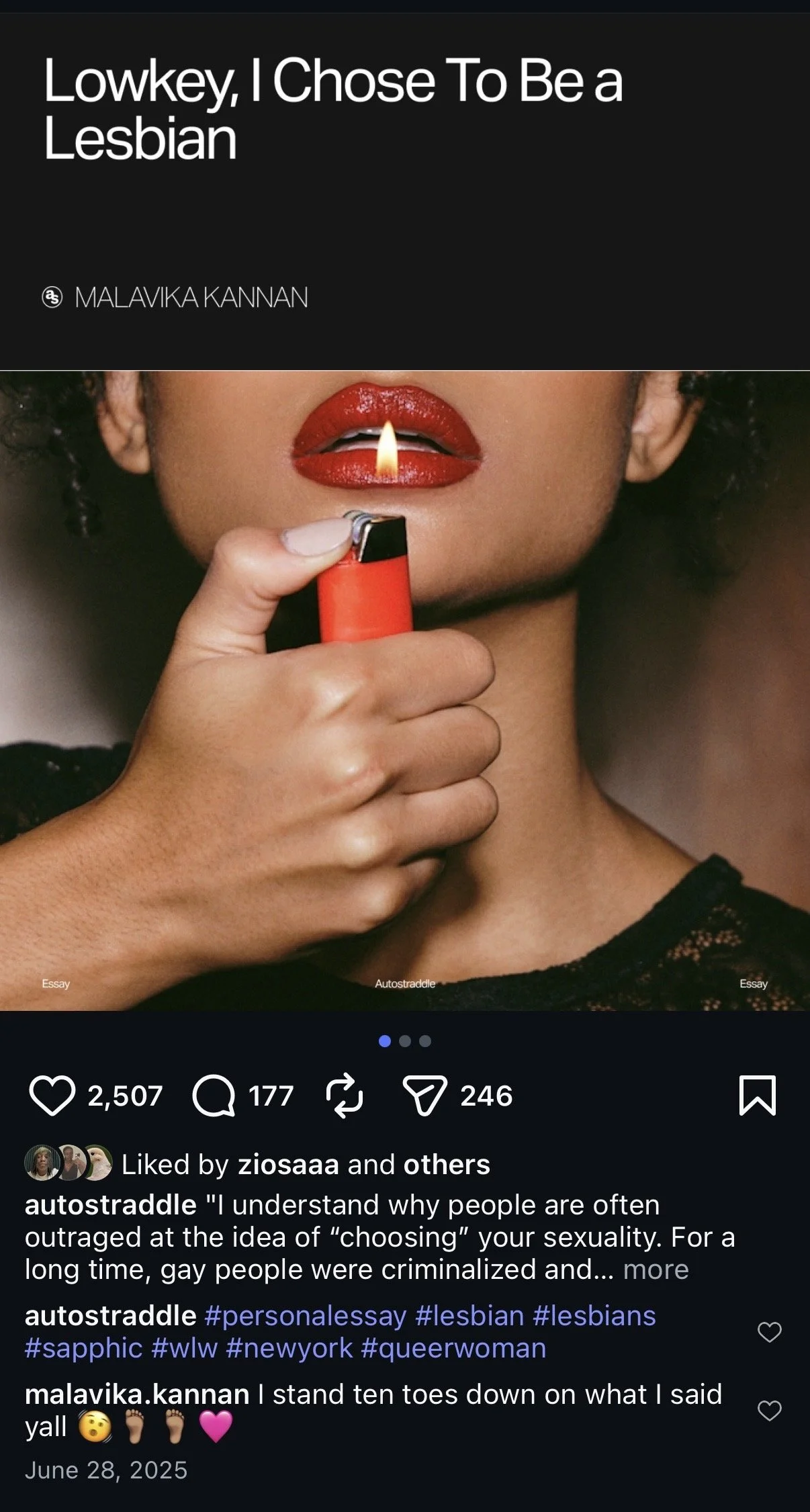
As I’m sure you’ve heard, the lesbians and bisexuals are fighting. Correction: the lesbians and one specific bisexual are fighting over the article“ Lowkey, I Chose To Be A Lesbian.” In this article, writer Malavika Kannan proudly admits that she is a bisexual who chose to“ become” a lesbian for political purposes. Despite the article being published by Autostraddle back in June of 2025, this dead horse is being resurrected and flogged all over the lesbian Internet. The piece has since been connected to Doechii’s recent coming out as a lesbian, and predictably, lesbians and bisexuals alike are critiquing it online, calling Kannan’s words harmful, reductive, and an affront to the lesbian identity.
The concept of a bisexual“ choosing to be a lesbian” perpetuates a dangerous rhetoric that sexuality is a choice and, therefore, can be undone. Not that men (generally speaking) have ever taken lesbian identity all that seriously, but these sort of bombast articles certainly aren’t helping matters. I feel uniquely qualified to comment on this discourse because I’m actually a lesbian who once, years ago, identified as bisexual and chose to prioritize my queerness but NOTABLY never called myself a lesbian. For a long time I avoided the label because I knew it would be terribly inappropriate to claim it until I felt sure of my lesbianism (which I eventually did). I couldn’t choose to be a lesbian, I could merely choose to act on my desires. I also didn’t have to know I was a lesbian in order to justify the removal of men, and that was soooo liberating. My priority was my queerness and the dykes I was in community with.
The overarching issue I’ve identified in Kannan’s essay is that it appears her priority in writing this is not the lesbian community. There is a clear emphasis on soothing the male ego. Kannan attempts relatability by lamenting the loss of men, which leads me to believe that perhaps her intended audience was not lesbians at all, but rather bisexuals (at best) and (at worst) the straight women that she claims she wants to“ open the wide house of queerness” to.
Exhibit A: the paragraph dedicated to reassuring the reader that she admires men:“ To be clear: I don’t hate men. Decentering is not demonizing. Although you will not catch me spilling ink over men — at least not since my pre-pubescent diary — I see their humanity. The dignity of fathers in Palestine, protecting and grieving their children amid unfathomable violence. The sort of grown men who give their seats, speak up, help carry heavy things. My sweet, ridiculously handsome gay male friends. This morning, I saw a group of long-legged teenage boys at the subway station. Gracefully, one of them stepped over the turnstile and then opened the door for the rest of us. I had never seen such a casual display of chivalry. There are moments I am taken by the grace of men, even as I choose not to center them.”
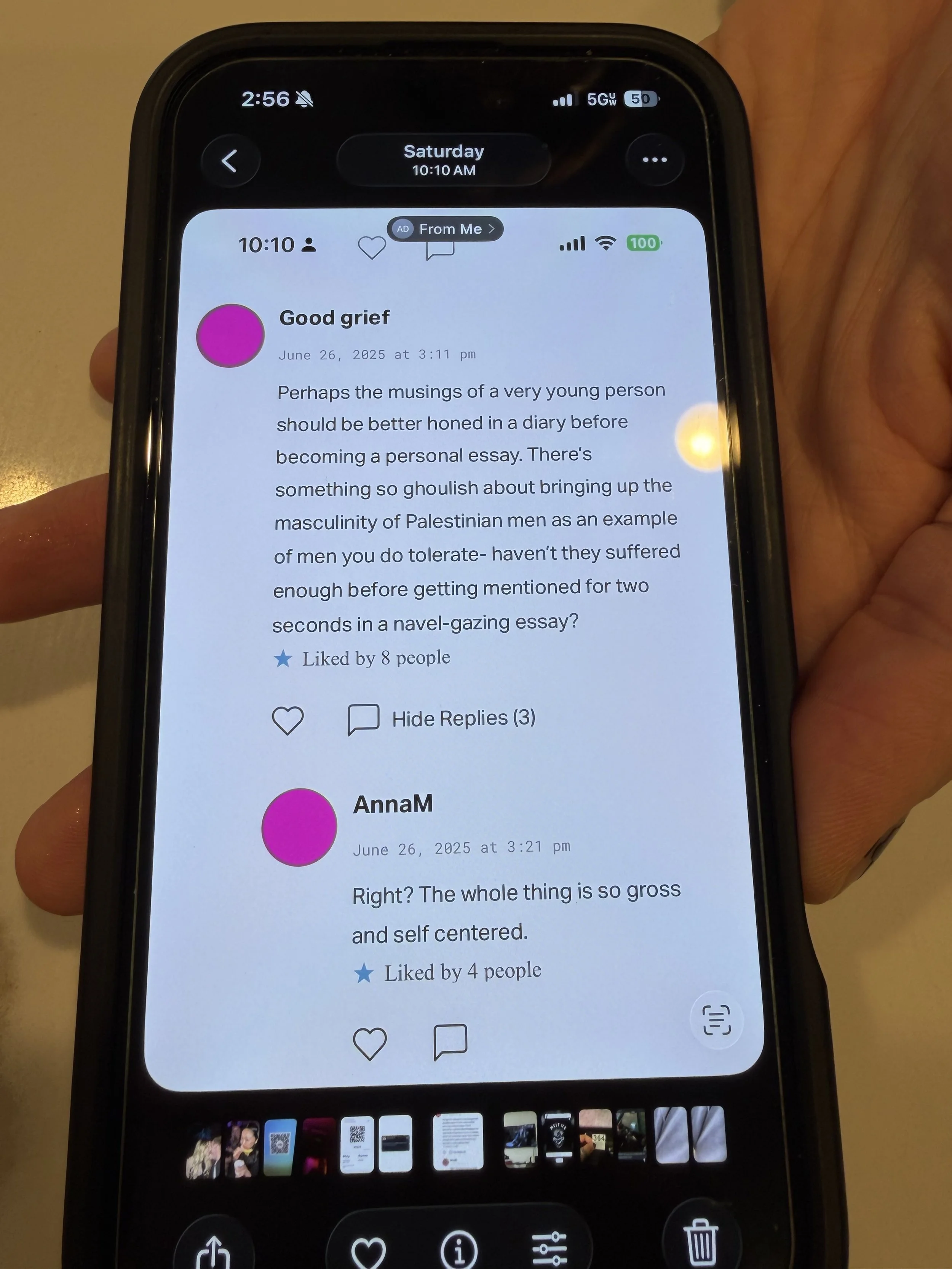
Screenshot of the Autostraddle comment section of“ Lowkey I Chose To Be A Lesbian” provided by local lesbian whom I encountered in a coffee shop
The way she waxes poetic (quite literally“ spilling ink”) about the uniquely male grace of lifting heavy things, opening doors and displaying chivalry feels like a slap in the faces of butches and even femmes who are more than willing and ready to take care of our community and often do. It’s very ironic to see an art form perfected by butch lesbians lauded as the main redeeming feature of man.
TikTok creator and essayist Paris Mwendwa critiques Kannan’s audacity“ to go into a space that is exclusively for women, [one] that is not being governed by male desire and male sexuality and male presence…and talk about your love of men and do all of this naval gazing about how you’re not going to give in to your love for men anymore.”
It seems like this essay, rather than expressing a genuine desire and love for women, begins and ends with men at the front of mind. Even the moment that initially sparked this conversation centers around a man. Kannan claims that the final straw for her was a pregnancy scare, which inspired her to run to the arms of lesbianism for refuge. Not to be the woke police, but this really rubbed me the wrong way. As someone who has topped and bottomed for plenty of trans lesbians, this (il)logical jump is either terribly naive or very telling.
The craziest part of all of this is that the article is— apparently— Kannan thrusting her very best ideas on the subject into the queer aether.“ I Lowkey Chose to Be a Lesbian” wasn’t an instagram rant or a leaked group chat; this article was pitched to, written, and edited for a well known and beloved publication. And yet, even in an article flaunting her sacrifice of men for the good of womenkind, she couldn’t finish the essay without literally admitting that being with a woman long term is not an imagined end-goal. Forget about lesbian, this is bad form even for a bisexual.
Towards the end of this essay she says:“ It’s easy for me, at 24, to hold out in my principles. I wonder what will happen when I get older. Our society has made it very structurally difficult for me to envision a life outside of partnership with a man.”
Kannan then laments what is, to her, the biggest downside of lesbianism: loss of male money? She elaborates by saying,“ I don’t think I can ever raise a family by myself in New York.” Whether or not this was her intention, presenting the two options as either raising a family with and being financially supported by a man or… being a single mother??? heavily implies that she cannot see a future with a woman or even fathom two women being successful enough or or capable of financially supporting a family. It begs the question: why do all of this, why set out to claim a label that doesn’t feel true to you, when you have explicitly stated that you’re“ not opposed to the bisexual label” and that“ I love women and queer people, but the things I love about them could feasibly belong to any gender.” Why write an entire article about this when you still seem unsure you could ever actually marry a girl?
The final nail in the coffin is the line,“ I don’t blame those who can’t hold out: Being a lesbian is not for the weak.”
Kannan fails to consider that perhaps the lesbians around her are not merely“ holding out”, denying their overwhelming urges to abandon the temporary sanctuary of the Isle of Lesbos and run headfirst into the arms of men. Actual lesbians often don’t find lesbianism to be a burden at all (hate crimes and lack of rights obviously excluded). For pretty much all the lesbians I know, myself included, lesbianism is actually their greatest joy and privilege in life.
“Kannan fails to consider that perhaps the lesbians around her are not merely “holding out”, denying their overwhelming urges to abandon the temporary sanctuary of the Isle of Lesbos and run headfirst into the arms of men. Actual lesbians often don’t find lesbianism to be a burden at all (hate crimes and lack of rights obviously excluded). For pretty much all the lesbians I know, myself included, lesbianism is actually their greatest joy and privilege in life.”
Overall the article has been largely regarded as an intellectual flop. But, I’m also interested in the seemingly endless virality of this essay. How is it even relevant so long after it was first published and how it is connected to a star as large as DOECHII?
The headline that seemed to overtake my TikTok FYP was that this article inspired Doechii to come out. Due to this game of Internet telephone, I was under the impression that Doechii had released some sort of personal statement praising Kannan’s article and promoting it as the impetus for her coming out as a lesbian. I also assumed that she had at some point claimed to also identify as a political lesbian. Many of the outraged TikToks filmed in response seem to equate Doechii’s lesbian identity with the experience described in Kannan’s article and that they are therefore BOTH bisexuals proudly masquerading as lesbians for “political” purposes. After actually looking into it, however, I couldn’t find anything from Doechii shouting out this article that supposedly inspired her so much. All I could find was Kannan’s own TikTok video captioned“ No revenge because DOECHII called my essay ‘powerful’ (and came out publicly [yesterday])” with the additional caption,“ Lesbian stock is going upppp.”
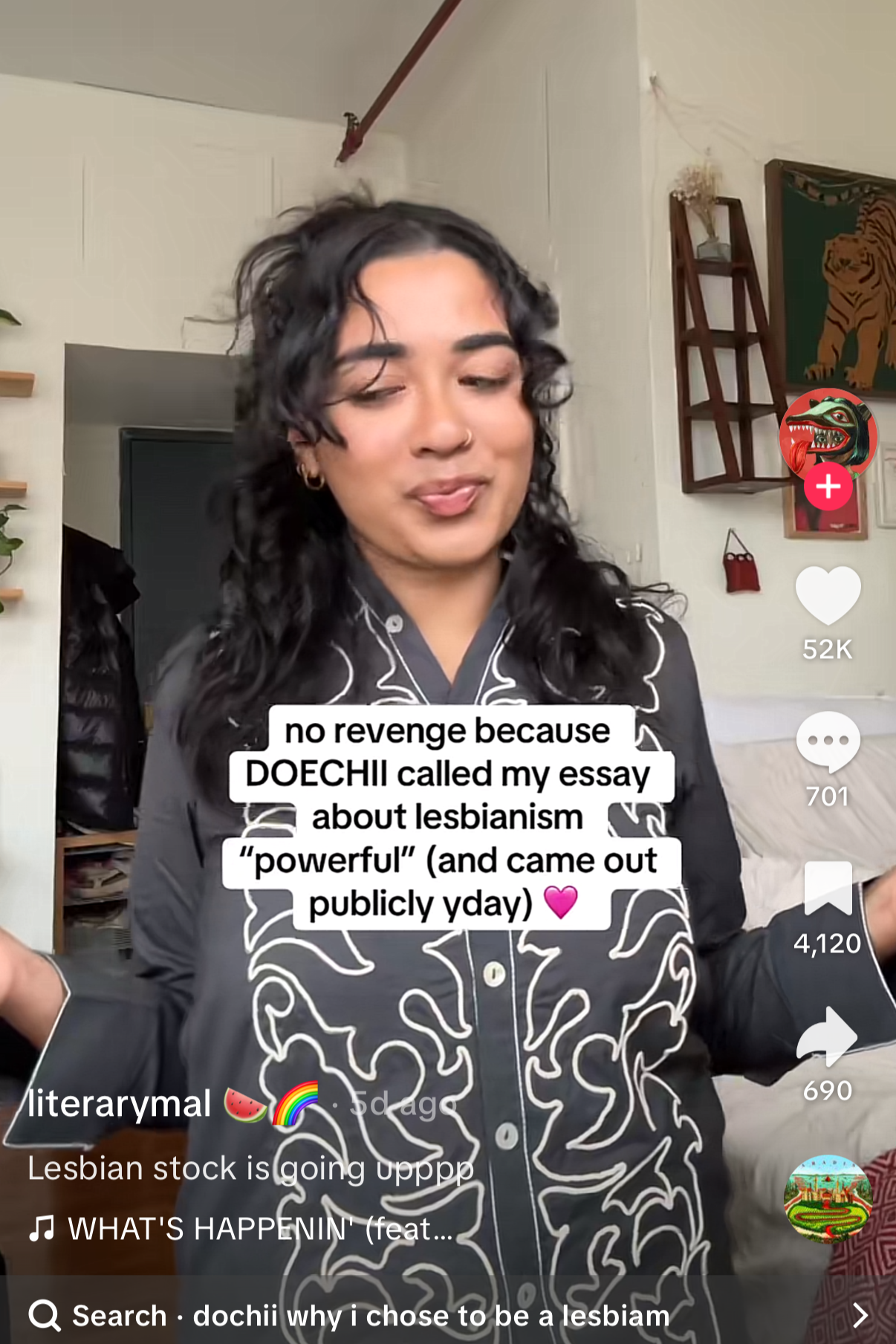
As of writing this, the video has 279.1K views, and since Doechii has not released any statement, we must assume that Kannan’s own video blowing up is actually what sparked this viral cancellation, uniting both lesbians and bisexuals against a common enemy. While there are screenshots of Doechii commenting on Kannan’s Substack essay on January 3rd of this year, the comment has since been deleted following the backlash.
With all this endless piling on from the community, it would be reasonable for any writer to take a break, collect their thoughts, and try to clarify their meaning and maybe apologize for any misunderstanding. Except this is actually the second time Kannan’s essay has been met with an onslaught of outrage, and she was just as unapologetic then as she is now. The article was actually torn apart both in the comments of the Autostraddle article and Kannan’s own Substack when it first came out back in June. The only place it seemed to receive praise was her own Instagram comments section. She responded to the criticism in the Autostraddle Instagram comments section (back when it was initially published) with the statement“ I stand ten toes down on what I said y’all.”
To know that this was received soooo poorly, and to still hop onto the virality of a Black woman’s coming out moment and tie her newly announced identity to your own (widely criticized) article is definitely a choice. Obviously, I was also looking at Doechii sideways for reading the same article we all did and publically (however public a Substack comment section can be) praising it. However, I still held out hope that when Doechii has the chance to say more that she might clear herself of the political lesbian allegations.
Eventually this patience was rewarded when, at 10:00pm on February 16th, Doechii released an official response via Twitter (I’m not calling it X lol):
“I want to gently clarify something. I read this Substack essay a while back and had honestly forgotten about it until recently. After rereading it, I realized there are quite a few things that don't align with my own views or experience and never did.
I feel like the way the TikTok was framed may unintentionally suggest that my "coming out" was motivated by the essay or that I fully align myself with it and that's not the case. While I do think the writing was honest/vulnerable (which is why I described it as "powerful"), my journey and perspective is my own.
I don't support any rhetoric that could feel/be harmful towards the girls.”
Malavika Kannan lowkey chose to get cancelled (for the second time) and appears to be refusing any opportunity to rehabilitate herself in the eyes of the very community she wants so badly to belong to.
Right now the flippant“ fuck the haters, I said what I said” vibe she’s been putting out is not working; instead, it’s digging her into a deeper hole. Even when every lesbian on the Internet has come together to critique her essay line by line, she still posts on Substack“ Don't hold your breath for a Notes App apology; I seldom repent!” and in a since deleted TikTok brushes off her critics, going out of her way to point out that she actually heard about this discourse from“ a baddie” who had just“ cracked” her (perhaps hoping to gain cool points for such an accomplishment). She also deflects criticism by claiming that her critics would rather align with a gold star lesbian who works for Lockheed Martin (an actual example she used). Like no, I wouldn’t rather my lesbians be evil. I would just rather they be lesbians. The label of lesbian is not a moral one.
Kannan then says people’s aversion to political lesbianism (without true lesbian desire backing it up)“ [erases] the political elements of lesbianism.” This response frankly feels like it was made in bad faith, and fails to address the actual issue people are having, which is her co-opting a label that has historically not been taken seriously. No one is saying that you can’t discover you’re a lesbian after previously identifying as bisexual or even straight. Malavika Kannan simply is not a lesbian point blank period.
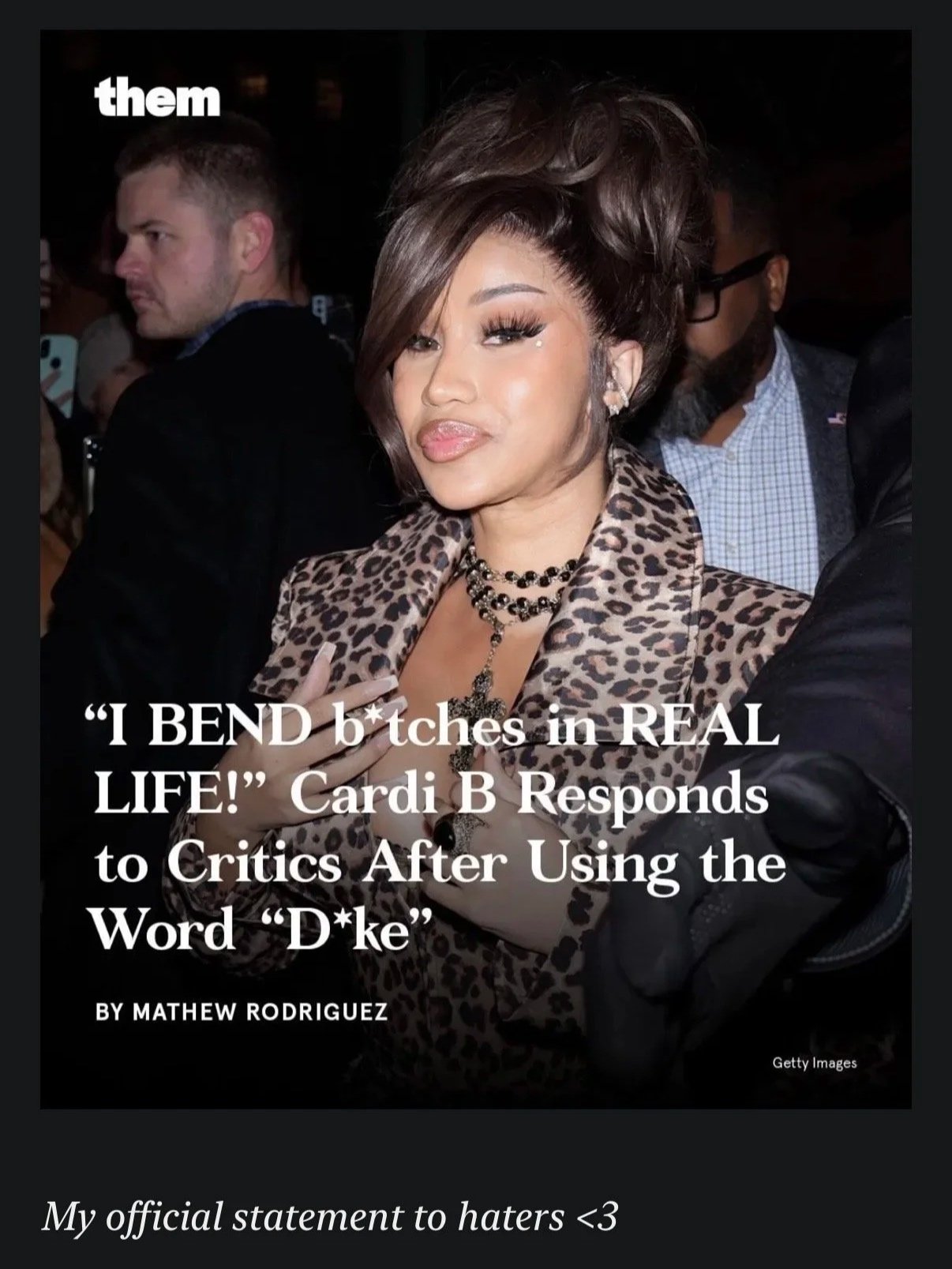
Her“ official statement to haters” posted on both her Instagram story and Substack is actually the Cardi B quote“ I bend bitches in REAL LIFE!” It seems she wants to come off as unbothered and firm in her opinions, but in reality her response comes off extremely out of touch. Kannan seems unwilling to reflect and downright smug in her ignorance. Once again, I must emphasize that this is the SECOND time that she has received backlash for this article so if she had anything to add, elaborate on, or clarify, she has had 8 months to do so. It all feels oddly reminiscent of Sydney Sweeney’s refusal to meaningfully address her American Eagle Ad. I do think this is an impressively difficult energy to mimic as a queer woman of color… nevertheless the comparison feels apt.
It’s worth noting that Kannan has used this viral cancellation as an opportunity to promote a book of essays she’s writing called“ RAGE BAIT.” Ironically, she’s apparently writing an essay for this book about bullying as a“ moral practice”, and perhaps a tool for correcting bad behavior. It’s because of this that I hope she might see this dog pile as the necessary albeit difficult to chew feedback that it is.
This article has been so poorly received that some are even questioning why a publication like Autostraddle would even publish something like this, but honestly I think Autostraddle was aware this might be controversial. I don’t fault them for publishing this article. Their job is not to censor ideas; it’s to spark conversation and perhaps create a bit of discourse. Even if it’s a widely disliked idea, it’s still an idea put out by a queer writer. But, your ideas don’t become infallible just because a large platform published it. The response online is part of the conversation and shutting yourself off to this input does not make you look smarter. You’re allowed to use this experience to develop as a person and a cultural commentator rather than hardening to any critique for the sake of protecting yourself.
You’ve put an idea out there and the queer community has responded. You’ve lost so much respect from your contemporaries and peers, as well as potential partners (as you self reported on your Substack, having already lost the interest of two separate people after they read the essay). Part of tending to your relationship with the lesbian community might need to involve taking that feedback and editing accordingly. Humor can be a useful yet temporary armor that I understand can feel easier than admitting that some ideas need workshopping. But lowkey, if you hadn’t gone as far as to take the lesbian label for yourself, if you’d just decided to exclusively date dykes while maintaining respect for words and labels (which mean things btw) this all could have been received much better. The idea of a bisexual forsaking men and embracing her queerness as inextricable from her politics could have been a powerful and exciting idea.
As lesbian TikToker petty mayonnaise aka @thebimbofemme said in a video about the essay,“ There is nothing radical or political about calling yourself a lesbian when you actually aren’t one. The best way that you can be radically, politically against the patriarchy is to openly and boldly state that you are in fact attracted to men but despite that attraction, refuse to be with men.”
Hilariously I actually wrote an essay back in December 2025 encouraging bisexuals to do just that, arguing that queerness is a beautiful thing and you don’t need to be a lesbian to justify exploring it. I also explicitly warned against taking over the lesbian label when it didn’t apply. I was very careful when writing that essay, even being a lesbian myself, because I know just how protective (and rightfully so) lesbians are over the lesbian label. I had too much respect for this to ever dare claiming it before it felt true. Choosing queerness didn’t automatically turn me into a lesbian, but it gave me the opportunity to discover that I was one, and it has honestly been the greatest relief and joy of my life.
Many bisexuals, like Kannan,“ dream of a world without labels at all,” which makes sense for people who, as Kannan describes herself,“ enjoy the gender buffet.” That is why there are a range of labels for people with multi-gender attraction (bisexual, pansexual, queer if you’re feeling a lil nasty). Lesbianism is notably not this. Not to say that it’s rigid, as lesbianism is already pretty damn fluid and takes into account the various trans identities that have always found a home within it (trans men of lesbian experience, nonbinary dykes, transfemme lesbians, etc.,). There is kind of just one category that is truly and unanimously disqualified from lesbian desire: cisgender men.
So to quote the article that started this all, no, “lesbianism is not for the weak.” Dare I say, lesbianism is for lesbians!