Fairytale Retellings: Why Marissa Meyer’s The Lunar Chronicles Still Hits Over A Decade Later
Written by Daphne Bryant
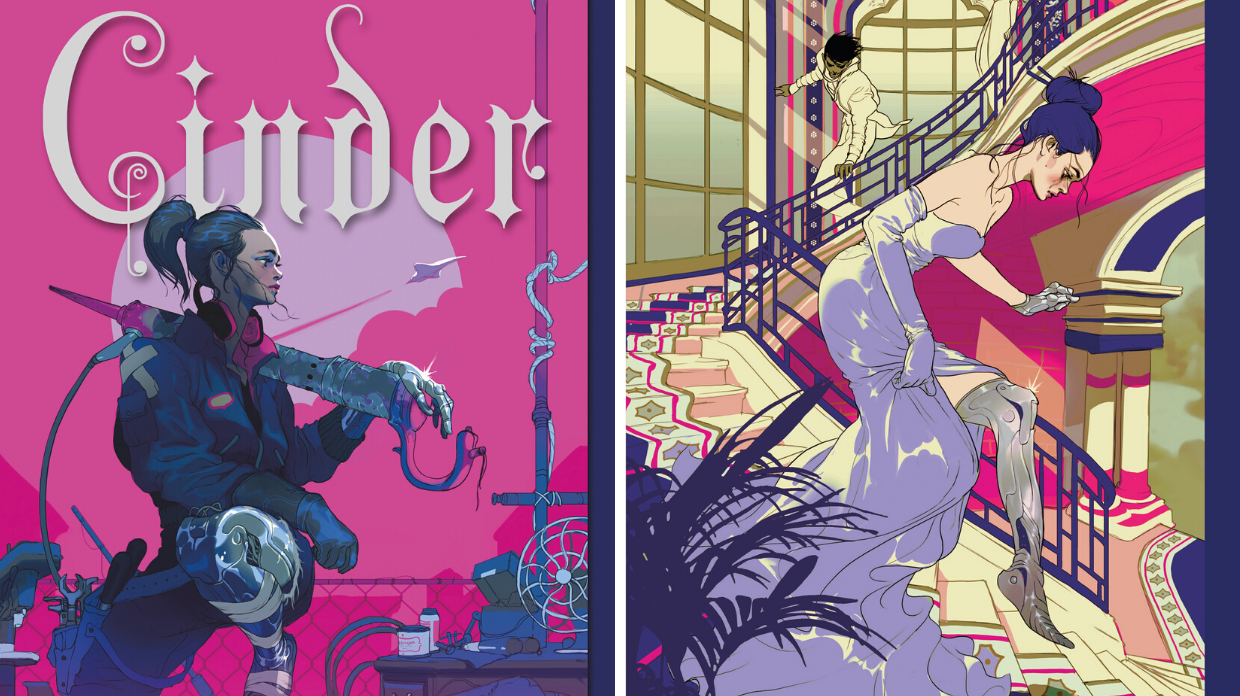
For better or for worse, I am the kind of girl who revisits books more than I take a chance on new ones. There’s just something about the nostalgia, that feeling of opening up a novel and immediately being transported back to your childhood, of re-discovering your favorite characters and worlds all over again.
The first time I heard of Cinder, I was at my friend Daisy’s house having a sleepover. She had a bookshelf in her room, and the original cover (with its striking cybernetic leg and ruby red slipper) stood out to me. I asked her:“ what is this?” And she explained that it was a sci-fi retelling of the classic Cinderella. If you want it you can take it, she said. I don’t want it.
Unbeknownst to Daisy, that small, casual gesture would end up changing my life.
As soon as I got home, I began reading Cinder, a story about a greasy cyborg mechanic with an evil stepmother and a desperate need to escape. Cinder was not your typical heroine. She was an exhausted working-class teenage girl, and despite her reluctant attraction to Prince Kai (her eventual love interest and the future king of the Eastern Commonwealth), she did not fawn over him or yearn for a crown herself. After all, she wasn’t allowed to have those kinds of dreams. In this universe, cyborgs are considered disposable and suffer from state-sanctioned discrimination and other sorts of severe mistreatment. She was an outcast, doomed.
I found myself relating to Cinder. Sure, I’m useless with a hammer and wrench and probably would’ve folded for Kai quicker than she did, but I definitely felt as though I was on the outskirts of society. As a nerdy, young Black girl growing up in suburbia, the way I navigated and moved through the world felt perpendicular to what others expected me to sound, act and look like. I was constantly balancing on the tightrope of being“ too much” for some spaces and“ not enough” for others. New Beijing offered a heightened mirror for that isolation. When characters recoiled at the sight of Cinder’s metallic hand, or when her stepmother reminded her of her so-called place, it struck a deep chord within me. Cinder the weirdo became something of a best friend and role model. The more I read, the more enthralled I became with this dystopian future, and the more I rooted for the people in it.
“Cinder the weirdo became something of a best friend and role model. The more I read, the more enthralled I became with this dystopian future, and the more I rooted for the people in it.”
If you have any interest in reinventing folklore for a modern audience, The Lunar Chronicles by Marissa Meyeris a must-read, the perfect case-study. This summer, in preparation for the Fantasy issue of Dreamworldgirl Zine, I decided to buy (once again) all four books in the series: Cinder, Scarlet, Cress and Winter. And let me tell you: it’s just as good as I remember! At the heart of the series’ success is Meyer’s brilliant and wildly ambitious world-building. She took stories we’ve heard a thousand times—Cinderella, Little Red Riding Hood, Rapunzel, and Snow White—and seamlessly transported them into a gritty, high-stakes future. For example, instead of a tower, Rapunzel (now Cress) is trapped in a spy satellite hacking Earth’s communication grids, and The Big Bad Wolf (now just Wolf and Scarlet’s love interest), is a bioengineered soldier from the moon (Luna) with razor sharp teeth and a manufactured instinct to kill. Roughly 300 years after a devastating global conflict called the Fourth World War, the solar system is in ruin, and a ragtag group of lovable losers is our only hope. In a lot of ways, this fantasy/sci-fi hybrid is reminiscent of many legendary 90s anime which Meyer has cited as influences. The Rampion crew’s chaotic dynamic is like a spiritual descendant of the Bebop—a bunch of space-faring misfits trading witty banter over subpar meals while flying a ship they can barely keep together. Meanwhile, the core quartet of girls mirrors the iconic, complementary chemistry of the Sailor Scouts. By trading magic wands for bioelectricity and royal carriages for spaceships, the series grounds magical archetypes in an imaginative science fiction setting.
“By trading magic wands for bioelectricity and royal carriages for spaceships, the series grounds magical archetypes in an imaginative science fiction setting.”
A great setting, however, means nothing without compelling characters, and this is where The Lunar Chronicles truly shines. Not only is this a series where lost princesses can lead revolutions, but it also happens to boast one of the most unique, memorable and tightly knit YA ensembles I’ve ever read about (IMO rivaled only by the crew in Six of Crows and The Gilded Wolves). Each book introduces a new perspective while expertly expanding on previous ones, so that a found family of outcasts, criminals, soldiers, hackers, and royals naturally emerges. Watching Cinder, Scarlet, Cress, Winter (and eventually Iko) come together, each with their own distinct strengths, vulnerabilities, and traumas, creates an incredibly satisfying emotional arc that keeps readers deeply invested throughout thousands of pages. Their sisterhood, for me, is one of the highlights.
“Each book introduces a new perspective while expertly expanding on previous ones, so that a found family of outcasts, criminals, soldiers, hackers, and royals naturally emerges. Watching Cinder, Scarlet, Cress, and Winter come together, each with their own distinct strengths, vulnerabilities, and traumas, creates an incredibly satisfying emotional arc that keeps readers deeply invested throughout thousands of pages. Their sisterhood, for me, is one of the highlights.”
So too, is Queen Levana. She is now one of my favorite villains (right up there with Preminger from Barbie as The Princess and the Pauper). When I was younger she used to just piss me off—I wanted her dead so badly—but now I see how genius her character is. Levana’s a chilling antagonist who rules through glamour, a hyper-curated, illusive and forced beauty that consumes her people and gives her a false and terrifying sense of security. Her body dysmorphia, misuse of power and obsession with control is an eerie critique of vanity and perfection that still hits uncomfortably close to home. If you’re curious to hear more about her lore, I recommend reading Fairest: Levana’s Story, a prequel that explores the dark past of this tyrannical Lunar queen.
Of course, revisiting an old favorite as an adult means coming at the text with wiser, more critical eyes, and there are some tropes of the era that haven’t aged quite as gracefully. Like, can we talk about the relentless heterosexual agenda? By the time the final battle looms in Winter, the main cast assembles itself into four tidy pairs of boy-meets-girl romances. And while they’re all well-done and I adore the male characters, as a bi girl myself I can’t help but think the story would feel so much more realistic with some queer rep. I guess that’s the job of fanfic writers though, huh? :(
“By the time the final battle looms in Winter, the cast organizes itself into four tidy pairs of boy-meets-girl romances. And while they’re all well-done and I adore the male characters, as a bi girl myself I can’t help but think the story would feel so much more realistic with some queer rep.”
The depiction of Winter’s mental illness also leaves a bitter taste in my mouth. Her hallucinations—a consequence of refusing to abuse her bioelectric power—are almost romanticized, for she is the“ mad but beautiful princess.” This archetype flattens what to me are clearly neurodivergent traits, and Winter is (at least temporarily) stripped of the well-rounded agency that the other girls are either freely given or take for themselves. Honestly, I think that everything regarding the“ Lunar sickness”, and the origins of Letumosis as well, could have been handled with a bit more care.
Ultimately though, The Lunar Chronicles remains a beloved cornerstone of young adult literature. To truly appreciate its impact, you have to look back at the landscape of 2012, when Cinder first dropped. YA was completely saturated with bleak, hyper-serious, post-apocalyptic survival stories, courtesy of The Hunger Games and Divergent’s popularity. Meyer’s debut series stands out to me because, despite the war-torn setting and heavy themes, it retained a sense of whimsical wonder, colorful romance, and camp missing from similar novels (we owe this to the fairytale origins, I think).
“Meyer’s debut series stood out because, despite the war-torn setting and heavy themes, it retained a sense of whimsical wonder, colorful romance, and camp missing from similar novels (we owe this to the fairytale origins, I think).”
God, I just love The Lunar Chronicles so much, and I love Marissa Meyer for gifting us with it. She taught me that anyone, regardless of where you come from, how much money you have, or what scars you harbor from the past, can rise to victory. The fantastical series is a masterclass in character development and genre-blending, and proves that some stories really are timeless.