Barbie: Princess Charm School: Fantastical Dreamscape or Dystopian Nightmare?
Written by Cece Blythe
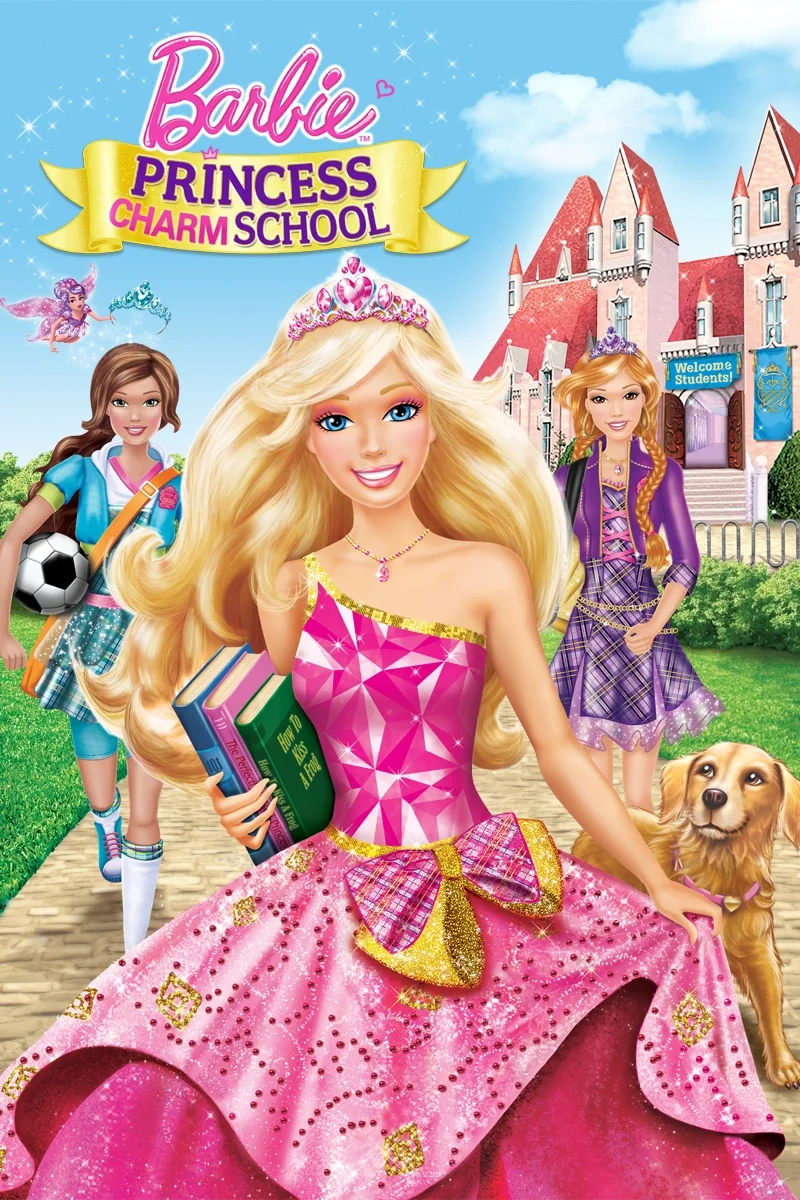
“You can tell she’s a Princess. She doesn’t need a crown.”
Opening lyrics that awaken the sleeper cell in an entire generation of girls. Something clicks when we hear those words, and we’re suddenly transported back to childhood, transfixed and in awe of the fanciful display of castles and crowns before us.
Barbie as a princess is not a new concept by any means: at this point we’d already seen her in Barbie as the Island Princess, Barbie as the Princess and the Pauper, etc. but Barbie: Princess Charm School felt entirely different. This Barbie felt approachable, relatable even. This Barbie could have been any of us. She wasn’t a born Princess (well...), or at least she wasn’t rich. She was adopted, living in a less fortunate neighbourhood, and working as a waitress.
Introducing Blair Willows, an ordinary girl hustling to support her ailing, single mother and younger sister. Early on in the film, Blair wins a lottery and is promptly enrolled in Princess Charm School—a magical preparatory school for young Princesses and Lady Royals. The school teaches etiquette and eloquence, readying the next generation of nobility for their life in high society. Naturally, Blair embarks on a cathartic journey from clumsy diamond in the rough to refined and upstanding Princess.
If we set aside the suspicious similarity to the little-known classic The Princess Diaries: a secret Princess, a Prince named Nicholas, an elegant yet domineering English tutor, an ugly-duckling-to-beautiful-swan metamorphosis, the quoting of Eleanor Roosevelt’s“ No one can make you feel inferior without your consent”, Barbie: Princess Charm School was quite revolutionary in that it humbled the protagonist from the start.
The appeal is obvious, from the magical makeover Blair undergoes at her locker, to those perfectly angular slices of strawberry swirl cake at the cafeteria and the rebellious alterations of those preppy uniforms (especially for a girl like me, who spent her early schooling squeezed into a clashing Catholic indigo ensemble that Barbie wouldn’t be caught dead in). I—and likely so many of you—wanted desperately to be the lottery girl, to be whisked into the life that Blair had. I tried hopelessly to balance books on my head, failing to emulate elegance, wishing I too had private princess tutoring to the sounds of Rachel Bearer’s overtly meta“ On Top of the World.” To top it all off, the story ends with every girl’s dream—Blair discovers she truly is a Princess, the lost daughter of the late Queen Isabella, and is crowned reigning Princess of Gardania.
Blair’s character gave us the hope that one day we too could blossom from our commoner cocoons into beautiful monarch butterflies. But now, 15 years later as I reminisce on the fantastical pageantry that defined our childhoods, the idea of Princess Charm School actually feels much more nefarious than our oblivious little brains could comprehend back in the day.
At its core, the very concept of an elitist Princess school is deeply Orwellian. It seems the only way Blair can save her family from complete destitution is by winning some arbitrary lottery. So, was Barbie subconsciously trying to teach us about the class system and its injustices? Is the Kingdom of Gardania a microcosmic caricature of our world, dulled down into a pretty, pink parable with a tiara on top?
Perhaps its goal was to pre-empt our discovery of the private school elite, and warn us that unless we are fortuitously bestowed with some miracle scholarship, those of us“ down here” will fail to compete against the Ivy League nepo babies and other dynastic elite. Perhaps it was a warning that despite all of Blair’s hard work and determination, us underdogs will never quite be on equal footing with them. It’s not until Blair joins (and tops) the 1% that she achieves any semblance of true parity.
Was the distinction between the Lady Royals and the trueborn Princesses a subtle nod to the disparaging social hierarchy within the 1%, where even the wealthiest in society struggle to garner the respect and influence wielded by the ultra-filthy-rich? Was Dame Devin’s framing of Blair and her friends for theft analogous to the manipulation of the criminal justice system, where the 1% shape the judicial narrative, influencing the few protections available to the subclass?
And what about those fairies? How did we never call into question the Personal Princess Assistants, the fairies at the students’ every beck and call, whose responsibilities range from performing makeovers and spa treatments, to accompanying Princesses on heists and carrying out dirty work for their superiors? Is it possible that this is an allegory for unpaid labor and exploitation? It seems that the fairy class is at the bottom of the enchanted barrel. I mean, do they have rights? Are they being coerced? Can they unionize?
These are the questions that boggle the mind on rewatch with slightly more social awareness than I had 15 years ago, and to which I regrettably do not have answers.
On a more optimistic note, Blair’s ethical character sowed the seeds for our own activism. In hindsight, it’s not hard to see why so many of us grew to be radical, libbed-up Social Justice Warriors. Having experienced the tribulations of a childhood in a rough neighbourhood (not unlike many Americans), Blair is fervently anti-eminent domain, protesting Dame Devin’s proposal for the Crown to displace the citizens living in poverty-stricken areas by bulldozing their homes and transforming them into parks. She recognises the dangers of a unilateral absolute monarchy. She knows to question unchecked power and to educate her silver-spooned classmates on the importance of social housing. I think it’s safe to say Blair would vote Mamdani.
Even when it is revealed that Blair is the rightful heir to Gardania, her morality remains. She never jeopardises her integrity and does good no matter what, ultimately choosing Delancy, who has been nothing but awful to her, to be her most trusted advisor as Lady Royal. Blair graced us with wisdom and taught us that remaining true to our friends and family is not only important, but necessary.
As Headmistress Privet would say,“ There’s a Princess in every girl.” Princess is very much a state of mind, and what matters more than anything—above title, above background, above predisposition—is confidence and character. The movie teaches us this, but it also conveniently sugarcoats the reality that in order to get there, we’ll need a bunch of luck, a personal mentor with political sway, an assistant with questionable free will, and nepotistic leverage.
Maybe the writers were saving face, not wanting to raise the eyebrows of concerned parents. Or, maybe they simply failed to realise the inferences that could be drawn from a system like Gardania, and that someday, their story would be over-analysed by a bunch of nostalgia-hungry 20-somethings with far too much time on their hands.
All things considered, perhaps a more astute takeaway would be“ All Princesses are equal, but some Princesses are more equal than others.”